nonfiction, historic Ireland, 1900s, speeches, quotes, politics, Britain, nationalism, paperback
LMODGiven to Jack during WW1 and War of Independence and Emergency
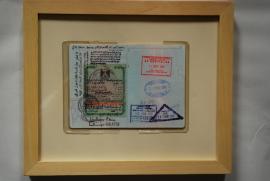
LMODThe Irish passport of Senator David Norris containing stamps from travelling including his trip to Iraq.
David Norris is a celebrated senator, Joycean and human rights campaigner who fought for the legalisation of homosexuality. He represents Trinity College graduates in the Senate, and is a spirited example of the Wildean principle that one’s life is, or should be, a work of art.
LMODA letter dated May 17 1996 from President Bill Clinton to Frank Feely, city manager, thanking him for his help during his trip to Ireland with the seal of the president at the top.
LMODA colour photograph of a group of people at the Pride Parade with banners behind them.
The 1993 Pride Parade was held the day after the old criminal laws were abolished, and the celebrations on the steps of the Central Bank were, in the words of photographer Christopher Robson, “wild and memorable.”
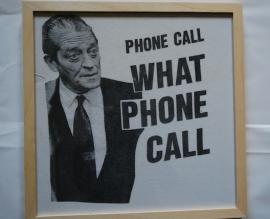
LMODFramed tshirt of black and white picture of Brian Lenihan Snr with the caption 'Phone call, what phone call.'
This t-shirt mocks Brian Lenihan during the 1990 Presidential campaign. The aging statesman was caught spoofing in one of those classic Irish Presidential campaigns (long and bitter). With his credibility damaged, Lenihan lost the election to Mary Robinson.
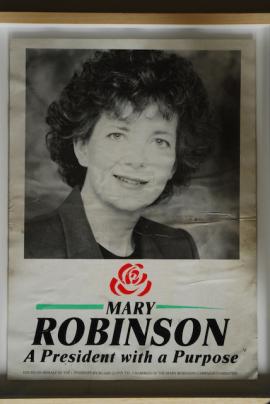
LMOD‘Mary Robinson A President With a Purpose’ slogan underneath a black and white photo of Mary Robinson.
Mary Robinson was Ireland’s first female President. Elected in 1990 as an independent candidate with the backing of Labour and the Workers’ Party, she was also the first president elected without the support of Fianna Fáil. Robinson began her career as a senator, fighting to liberalise Ireland in the 1970s – access to contraception was one of her early causes, as well as abolishing a legal requirement that women in the civil service leave their jobs if they married. She was a legal advisor to the Campaign for Homosexual Law Reform, which eventually succeeded in overturning Ireland’s ban on homosexuality in 1992. As President, Mary Robinson revitalised the office, before becoming United Nations High Commissioner on Human Rights.
LMODJohn Gormley election poster for the Green Party. Has the text 'Others promise the moon only we guarantee the earth!' in black and green. Shows a black and white picture of the view of earth from the moon and one of John Gormley.
The Irish Green Party was founded in 1981 as the Ecology Party, changing its name to the Green Party in 1987. This poster is from the 1989 general election, the first time that the party used pictures of the candidates; they had been wary of the ‘cult of personality’ in politics. That’s why the picture of the earth is the same size as the picture of the candidate. The Greens did much better than anyone expected in the election, but no one in the party had much political acumen, so they only won one seat. John Gormley was eventually elected to Dublin City Council in 1991, served as Lord Mayor from 1994-95, and later led the party in a coalition with Fianna Fáil.
LMODTwo bullets mounted on a sizable rock from Cullyhanna Graveyard in Armagh with 3 silver plaques bearing the words 'October 16th' 'Ben Dunne 1981' and 'October 22nd'. All of which is mounted on a wooden block.
On the 16th of October, 1981, Ben Dunne Jnr. was kidnapped by the IRA on his way to open a new Dunnes Store in Portadown. Before his release on the 22nd of October, two of his abductors gave him these bullets and told him that they could easily have been used – one on him and the other on Fr. Dermot McCarthy. Fr McCarthy had tried to secure Dunne’s release, making a plea on television and at one point meeting with Dunne’s kidnappers. McCarthy was nearly shot in crossfire. After his release, Ben Dunne mounted the bullets on a piece of stone from the cemetary in Armagh where he had been held captive.
LMODA pink poster with a black and white design of a radio and the caption 'RTÉ News - Are you getting the full facts' 'Repeal section 31 of the Broadcasting Act'
During the Troubles, censorship was used to silence Sinn Féin and the IRA. Under Section 31 of the Broadcasting Authority Act, it was forbidden to broadcast the voice of Sinn Féin members. This rule was brought in by Fianna Fáil’s Gerry Collins in 1971 and strengthened by Labour’s Conor Cruise O’Brien in 1977. The ban was upheld by the European Commission of Human Rights in 1991, but repealed two years later as part of the peace process.
LMOD