Black and white photograph
Sem títuloPopular Culture & Entertainment
187 Descrição arquivística resultados para Popular Culture & Entertainment
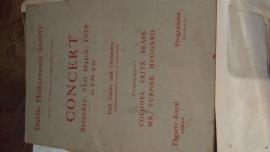
Program 1928
Sem títuloSouvenir Program
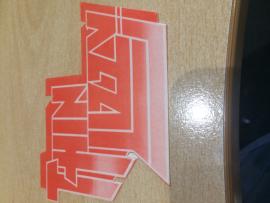
Sem títuloProduced by Phonogram Records in 1970s when Thin Lizzy was signed to the label
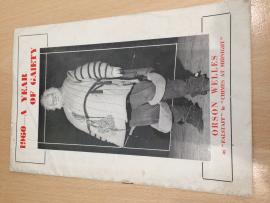
Sem títuloCommemorative programme for the Gaiety Theatre- featuring Orson Welles
Sem títuloSet of 2 badges for the Lambert Puppet Theatre.
- Picture of Mr. Crow on a white background with red text.
- Picture of a dog on a red background with white text.
These two badges were produced by the Lambert Puppet Theatre, a much-loved local institution. Founded in 1972 by Eugene Lambert and his family, it was Ireland’s first purpose-built puppet theatre. The theatre also produced television programmes, including Wanderly Wagon and Bosco. Mr. Crow, depicted on one of the badges, was a character from Wanderly Wagon.
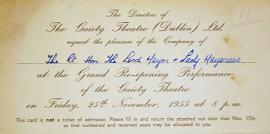
Sem títuloAn Invitation from the Director of the Gaiety Theatre to the Lord Mayor of Dublin and Lady Mayoress inviting them to the reopening of the Gaiety Theatre on Friday 25 November 1955.
An invitation to the Lord Mayor of Dublin to attend the performance that re-opened the Gaiety on the 25th of November, 1955. The Gaiety had been forced to close ten months previously when Dublin Corporation condemned the upper circle balcony as unsafe. The auditorium had to be redesigned with safer exits before the Gaiety could re-open. Denis Larkin, son of the famous labour activist Jim Larkin, was Lord Mayor at the time.
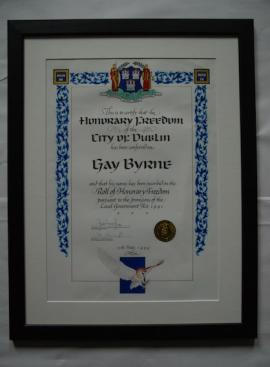
Sem títuloGay Byrne's Honorary Freedom of the City of Dublin awarded on 11 May 1999. It has a picture of the Late Late Show owl on the bottom.
Gay Byrne hosted RTÉ’s flagship talk show, the Late Late Show, for 37 years from its first broadcast in 1962. Byrne was a major catalyst in the transformation of Irish society, riffing on abortion, contraception and homosexuality. The Late Late Show featured an owl on its opening credits, hence the owl’s appearance on Byrne’s freedom of the city award. Byrne retired in 1999, but still pops up on Irish television.
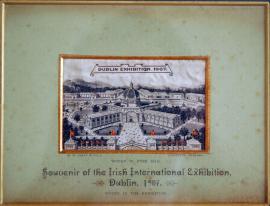
Sem título2 pictures woven at the exhibition. The first of a Dublin scene in black and white with red details, gold trimming and bordered by green. The second of of O'Connell (Sackville) Street and Bridge in black and white with gold trimming and bordered by green.
The Irish International Exhibition was the key social event of the first decade. It was hosted on the grounds of Herbert Park in Ballsbridge between May and November of 1907. The aim was to promote domestic industry by showcasing Irish products, as well as encouraging the development of commercial links by inviting all countries to exhibit their goods. Nearly three million visitors came to ogle at everything from industrial machinery to fine art, but the main attraction was a full-scale Somali village and the rare whimsy of a water chute and switchback railway. One of these pictures shows the central exhibition hall; the other captures a scene from O’Connell Bridge.