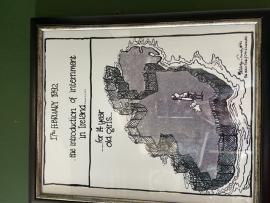
Sportscar burning beside Trinity College on South Leinster Road, part of Dublin and Monaghan bombings
Sem títuloMedia
110 Descrição arquivística resultados para Media
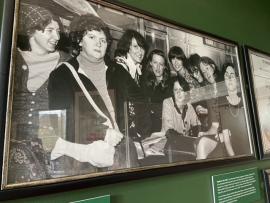
L to R: Maeve Donelan, Nell McCafferty, Mary Maher, Geraldine Kennedy, Renagh Holohan, Gabrielle Williams, Christine Murphy, Mary Cummins and Caroline Walsh
Sem títuloX Case when 14yr old rape victim was forbidden from gong to Britain to access abortion
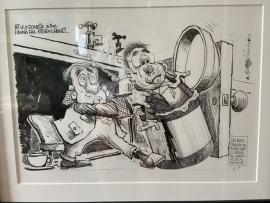
Sem título"bit of a domestic in the Fianna Fail kitchen cabinet" "like being savaged by a dead sheep is, I believe, the correct political response"
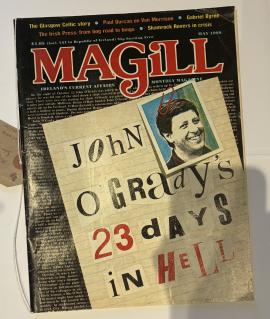
Sem títuloJohn O' Grady's 23 Days in Hell
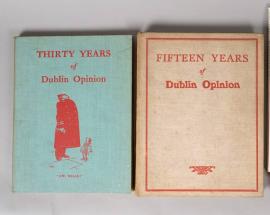
Sem títuloFrom 1952 and 1937 by Arthur Booth, Thomas Collins, Charles E. Kelly
Dublin Opinion was an Irish satirical magazine, published monthly from 1922 to 1968. It was founded by cartoonists Arthur Booth and Charles E. Kelly and writer Thomas J. Collins. Booth was its first editor, and drew the covers of the early issues. The first issue was launched on 1 March 1922, and its entire print run of 3,000 sold out. The sales rose to 40,000 per issue within a few years and 60,000 at its peak.
Launched on the eve of the Irish Civil War, the magazine's editorial stance was carefully balanced between Free Staters and Republicans, and its satire was generally gentle, albeit less so when it came to Britain and northern Unionists. After Booth's death in 1928, Kelly and Collins took over as joint editors.
By the mid-1960s, its popularity had begun to wane. Kelly and Collins sold it to Louis O'Sullivan in 1968, under whose ownership it returned briefly, edited by Lelia Doolan and Joe Dowling.
Evening Press with Eamon De Valera on the cover 1961
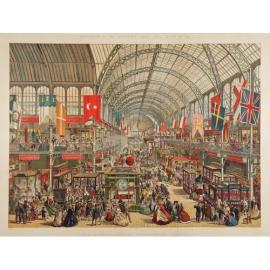
Sem títuloColour print by Leighton Bros. Supplement to the Illustrated London News August 10, 1865.
Sem títuloPaper published by anti-Treaty side during the Civil War. Includes headings 'Lawful and Unlawful', 'Castle Tactics', 'In The Field', 'In The Prisons', 'Why Gavan Duffy Retired'. Also includes information on attacks and raids as well as lists of the wounded and killed.
In this edition of the Anti-Treaty forces newsletter the moral authority of the Free State Government is called into question. The infamous British threat (during the Treaty negotiations) of “immediate and terrible war” is offered as the only reason for their coming to power. There is also a list of men, formerly seen as heroes during the War of Independence, who have been thrown into Free State jails and subjected to “scandalous treatment” at the hands of their former comrades.
bound issues of Dublin Penny Journal, 1832-33, Volume 1, Nos. 1,2,3,4,9,11,17,18,22,24,25,28,51, Volume 2, Nos. 1,28,47,48,51,52,50,97
Sem título