Showing 88 results

Archival description
48 results with digital objects Show results with digital objects
1910s HMS Dublin Flag
IE LMOD 596 · Item · Twentieth Century

A navy blue flag with the British flag, a Union Jack, in the top left corner that was the ensign on the HMS Dublin. Can also be dated 1927.

The Battle of Jutland was one of the key naval engagements of the First World War. HMS Dublin played a part in the battle, which was fought in 1916. The ship had been adopted by a committee of Dublin citizens and businessmen who raised funds to provide it with a band and other amenities. When the ship was decommissioned in 1926, Dublin Chamber of Commerce was presented with its battle-scarred ensign – complete with Union Jack – and in turn the Chamber donated it to Christ Church, since when it has languished, unseen, in the cathedral crypt.

LMOD
IE LMOD 285 · Item · Twentieth Century

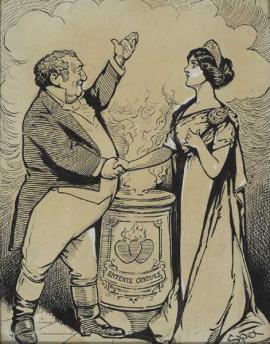
A black and white picture with white highlights of John Bull (Britain) and Hibernia (Ireland) shaking hands circa 1912, signed in lower right corner.
This cartoon by John Fergus O’Hea shows John Bull (Britain) and Hibernia (Ireland) shaking hands in front of the burning fire of an Entente Cordiale. O’Hea, who worked under the pseudonym Spex, was one of the most prolific Irish political cartoonists of his time. The cartoon suggests that love is in the air, although Hibernia seems a little unsure.

LMOD
IE LMOD 4 · Item · Twentieth Century

Poster. Quote from Lord Kitchener - 'Be honest with yourself. Be certain that your so-called reason is not a selfish excuse.'
Lord Horatio Herbert Kitchener, the iconic face of British army recruitment posters and Secretary of state for war, was born in County Kerry in 1850. Why should Irishmen fight for the English? Ulster Unionists saw it as an opportunity to showcase their loyalty to the Empire. The Nationalist community was divided, with Irish Parliamentary Party leader John Redmond encouraging Irishmen to join up and fight for Home Rule, while others saw “England’s difficulty as Ireland’s opportunity.”

LMOD
IE LMOD 739 · Item · Twentieth Century

This stool was made with a shutter from 11 Harcourt Terrace. The shutter is marked by bullet holes from the 1916 Rising. In 2011 James Carroll hand-crafted the stool in his workshop in the Wicklow mountains, using cleft ash. Carroll uses materials often discarded or passed over by others, bringing the pieces to life with traditional Irish craftsmanship.

LMOD
IE LMOD 7 · Item · Twentieth Century

Handwritten list of deceased by Senior Surviving Officers of the Garrison filed under headings 'Executed', 'Killed in Action', 'Died from Wounds', and 'Died in After Years' signed by Richard Mac Cormick, Capt. ICA. Includes Madam Markievicz.
Michael Mallin’s garrison of 200 men was camped across the road in the Green during the Rising. (Countess Markiewicz was his second-in-command.) The square was surrounded by high buildings, which made the rebels easy targets for the British forces. Each morning both sides halted fire in order to let the ducks in the Green be fed. Eventually the rebels were forced to retreat to the Royal College of Surgeons on the other side of the Green. The casualties are remembered on this gory souvenir placard from the 1940s; as you can see, Mallin was executed for his part in the Rising.

LMOD
1918 Sinn Fein poster
IE LMOD 1194 · Item · Twentieth Century

Poster that says Sinn Fein and The Others, declaring who voted for independence and who remained loyalists

LMOD
IE LMOD 275 · Item · Twentieth Century

Letter dated 7 October 1921, appointing Arthur Griffith, Michael Collins, Robert C Barton, Edmund J Duggan and George Gavan Duffy as Envoy Plenipotentiaries in both English and Irish (the Irish copy is embossed with the seal of the president) signed by Éamon De Valera. Also a list of instructions and rules for the plenipotentiary team.
This is the most important historical document in the museum. Appointing Dáil Éireann’s delegation for the Anglo-Irish Treaty negotiations, it includes signed instructions from Éamon de Valera, who had recently been chosen as Dáil President by his colleagues. It is one of five original copies, and for 40 years the document languished at the back of a filing cabinet in a law firm on Ormond Quay. The exact role and powers of the plenipotentiaries would be disputed in the bitter debate that surrounded the Dáil’s ratification of the Treaty.

LMOD
IE LMOD 468 · Item · Twentieth Century

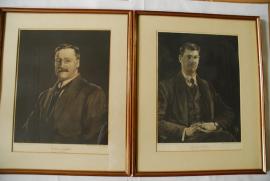
Black and white portrait prints of Michael Collins and Arthur Griffith by John Lavery captioned respectively as Chairman Provisional Government and President Dáil Eiréann.

These famous portraits of Michael Collins and Arthur Griffith by Sir John Lavery were painted during the Civil War. Collins and Griffith were members of the delegation that signed the Anglo-Irish Treaty in 1921. The Treaty did not provide full independence from Britain, Northern Ireland would remain part of the UK and an oath to the King would have to be sworn by all members of the Dáil. The Civil War broke out, which the anti-Treaty side eventually lost. Collins and Griffith were both dead by the end of the war – Collins killed in an ambush, Griffith succumbing to heart failure.

LMOD