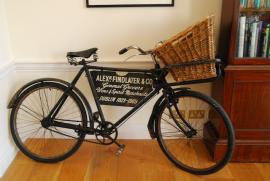
Black 1930s bicycle with wicker basket. Text 'Alex Findlater and Co. General Grocers Wine and Spirit Merchants, Dublin 1823 - 1969' on side of bike. Small wooden plaque on basket with text 'Alex Findlater & Co Ltd, A.I. Old Irish Whiskey, Trade AI Mark, Dublin, Rathmines, Blackrock, Kingston, Sandymount and Howth'
Alex Findlater and Co. started life in 1823, trading whiskey, wine and beer. The company expanded rapidly, adding general groceries to its alcohol trade, and became a major institution, with branches all over the city. This delivery bicycle was used by the company in the 1930s. (It was also used to launch the first annual Bloomsday Messenger Bike Rally in 1993.) Ultimately, pressure from supermarkets became too much for Findlaters’ more traditional service – as William Findlater had predicted at a 1902 staff meeting: “This brings up the question of packet goods, which is one of the curses of the trade, unless they bear our own brand. If this is encouraged much further it will mean the passing out of the grocer, and he will be replaced by a mere hander-out of packet goods, or, we will have nothing but girls behind our counters, which may be unpleasant to many of the young men present!”
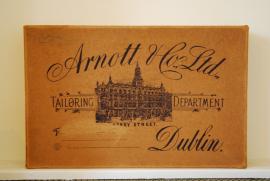
Cardboard box with picture of Arnotts on Henry Street and words 'Arnott and Co Ltd. Tailoring Department Henry Street, Dublin' Can also be dated 1949.
Established at 15 Henry Street in 1843, Arnotts was for many years the largest department store in Dublin. Patrick Pearse allegedly stopped off to settle his account on his way to the GPO on the day of the Rising. In recent years the store has become a prominent victim of the recession.
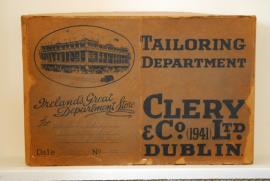
LMODCardboard box from Clery's with a picture of the store and the captions 'Ireland's Greatest Department Store' 'Tailoring Department' 'Clery and Co.(1941) Ltd. Dublin'
A box from Clery’s tailoring department in 1941. Clery’s was founded as ‘The New or Palatial Mart’ in 1853, bought over and renamed by M. J. Clery in 1883. The current building – which is modelled on Selfridge’s of London – dates from 1922, the original having been destroyed during the Easter Rising. In 1943, this much-loved department store was taken over by the Guiney family, who also owned the nearby Guiney’s department store.
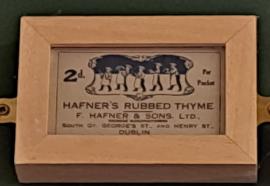
LMODA green envelope with blue writing for Hafner's Rubbed Thyme. 'Hafner & Sons, Ltd., South Gt. George's St., and Henry St., Dublin." Also has a drawing of five butchers.
LMODA white notice with red writing telling customers how to set their Hafner's sausages in order to keep them for a few days.
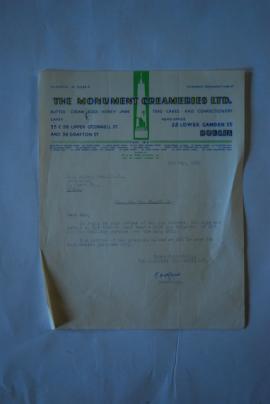
LMODLetter headed letter from The Monument Creameries Ltd dated 4 May 1950 in regards to 46 Upper Baggot St and the valuation of the property.
LMODYellow writing on a black and red background Gold Flake sign hanging from a metal bar.
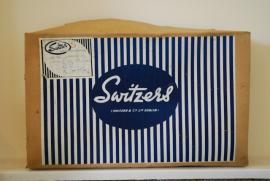
LMODCardboard box with dark blue/navy and white stripes with Switzer's logo 'Switzer and Co Ltd Dublin'. Delivery information in the top right corner. Seams are stapled together.
Grafton Street was anchored by Switzer’s and Brown Thomas department stores. Switzer’s was the less elite of the two – many customers never crossed the street to shop in Brown Thomas. The basement café was an old-fashioned parlour with waitresses in black dresses and white aprons. Switzer’s was bought by Brown Thomas in 1995; BTs moved into the Switzer’s building across the street. You can still see the Switzer’s logo on the Wicklow Street side of Brown Thomas.
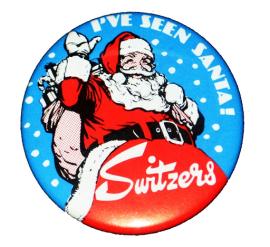
LMODI've Seen Santa' badge for Switzers with a picture of a waving Santa.
Switzer’s department store had the best in-house Santa Claus, and their Christmas window displays were a seasonal benison. With lights, music and animatronic puppets, people would make trips from all over the country just to visit this much-missed institution.
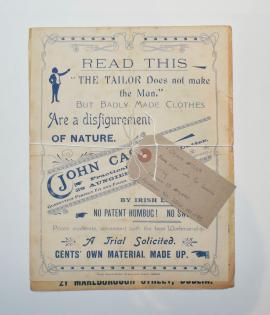
LMOD3 X Pamphlets advertising Caslin tailoring, with an image of 2 gentlemen on it. Address for Caslin Tailor shop is 21 Marlborough Street. 1 X Pamhplet advertising Caslin Tailoring with address as 1=29 Aungier Street. Good condition.
LMOD