Showing 70 results

Archival description
43 results with digital objects Show results with digital objects
1910 Scoil Éanna Prospectus
IE LMOD 445 · Item · Twentieth Century

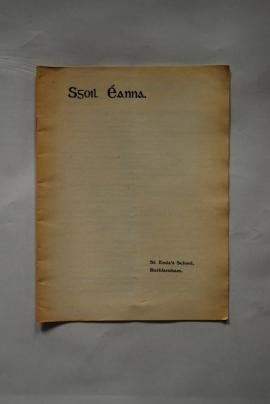
Prospectus for St. Enda’s School, Rathfarnham for year 1910 – 1911 Head Master Pádraig Pearse

This school prospectus encapsulates the two great loves of P.H. Pearse’s life: education and the Irish l anguage. Greatly encouraged by the example of Belgian schools, in 1908 Pearse founded Scoil Éanna in Ranelagh, a bilingual school for boys, followed shortly in 1910 by a girls’ school, Scoil Íde. As well as teaching through both Irish and English, Pearse pursued and pioneered a child-centred approach to education. His 1912 collection of essays, The Murder Machine, was an indictment of the British education system, placing Pearse at the forefront of educational innovation.

LMOD
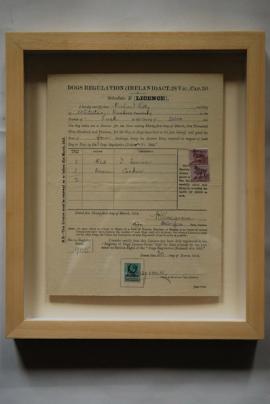
1912 Dog Licence
IE LMOD 457 · Item · Twentieth Century

A stamped license for 2 dogs under the ‘Dogs Regulation (Ireland) Act, 1865’ dated 30 March 1912.

From the minutely-detailed collie on the stamps to the requirement for the clerk to sign the form in two separate places, this Dog Licence is no simple record of payment. It is a monument to the fusty bureaucracy of the British Empire.

LMOD
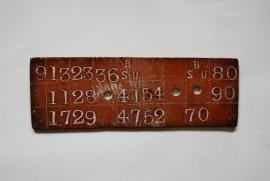
IE LMOD 397 · Item · Twentieth Century

Lr Gardiner St. Possibly 1930s – regularly stolen to heel shoes so holes were put in to stop that. Brown with numbers evenly spaced and with 3 holes. Also has initials BSU on it twice.

In the 1930s the Butchers Social Union found themselves faced with a mystery. Their leather bingo cards kept going missing. One day someone noticed that bingo players were stealing the cards to patch holes in their shoes. So the Union decided to stamp several holes in the cards, thus foiling the thieves.

LMOD
IE LMOD 273 · Item · Twentieth Century

Wooden grip test with display showing strength of grip in ounces as well as two small displays with list of average grip strength by profession and lights

LMOD
1950s Children's Typewriter
IE LMOD 1753 · Item · Twentieth Century

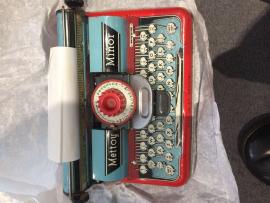
A 1950s era typewriter for children, Mettoy Minor

LMOD
1950s Public Telephone Sign
IE LMOD 353 · Item · Twentieth Century

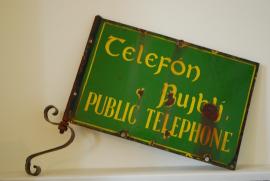
Green sign with yellow writing 'Telefón Puiblí Public Telephone'

LMOD
1950s Ronnie Drew's Passport
IE LMOD 566 · Item · Twentieth Century

Irish passport of Ronnie Drew from The Dubliners. The left page has Drew's personal details written in, including profession as 'salesman'. The other page has two photos of Drew, one clean shaven black and white photo, the other sepia toned with a metallic look to it and with a beard and embossed with official seal. It's signed 'Ronald Drew'. Both pages are stamped.

Ronnie Drew was a great singer and folk musician, famous as the frontman of The Dubliners. Born in Dún Laoghaire in 1934, he founded the Ronnie Drew Group with Luke Kelly, Barney McKenna and Ciarán Bourke in 1962. Soon after, they changed their name to The Dubliners.

LMOD
1960s The Great Marvello
IE LMOD 513 · Item · Twentieth Century

Brightly coloured general knowledge board game 'The Great Marvello' with a black and white picture of Éamon Andrews. Contains 4 reversible quiz sheets and a plastic Marvello figure.

In this ‘magic robot’ game, a figurine tries to rotate to the correct answer. (Magnets, dear boy.) The game’s impresario, Eamonn Andrews, went to school in Synge Street CBS, just south of here. Andrews is best remembered as presenter of This Is Your Life, which he fronted for nearly 30 years until his death in 1987.

LMOD
IE LMOD 548 · Item · Twentieth Century

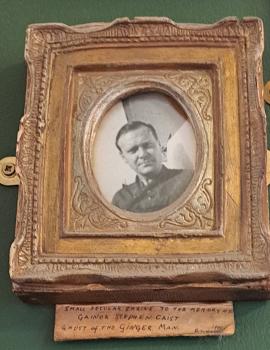
A small secular shrine with a black and white photo of Gainor Crist in a bronze coloured frame with the caption 'Small Secular Shrie to the Memory of Gainor Stephen Crist Ghost of the Ginger Man. 1995 D MacNamara' and on the back is written 'This is the ginger man's only memorial. Hang it where boozers booze, but fix firmly to wall. I couldn't find Paddy O'Briens, or any other ghost in McDaids so - It has to be Grogans. Mac'

LMOD
IE LMOD 304 · Item · Twentieth Century

Red writing on white background poster for a charity collection. ‘On behalf of the deserving poor of Dublin’ ‘Support Dublin’s Oldest Charity’
Dublin’s oldest charity was founded in 1790 as The Charitable Society for the Relief of Sick and Indigent Roomkeepers of all Religious Persuasions in the City of Dublin. The founders were a group of concerned middle-class men – including a grocer, a schoolmaster and a linen-draper – who wanted to alleviate the poverty in Georgian Dublin long before any government social welfare schemes.

LMOD