Showing 2102 results

Archival description
1012 results with digital objects Show results with digital objects
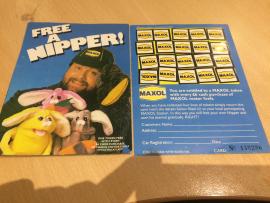
Free A Nipper Maxol Cards
IE LMOD 1723 · Item · Twentieth Century

x2 Maxol Cards for the Free A Nipper Campaign

LMOD
IE LMOD 2348 · Item · Twentieth Century

Friends of the Guinness Perspex ashtray 'Guinness isn't Good for You'.

LMOD
Funeral Ledger
IE LMOD 287 · Item · Twentieth Century

Nichols of Lombard Street Funeral Ledger No. 32 which includes Jack B Yeats
This ledger from Nichols Undertakers records the details for the funeral of the painter Jack B. Yeats, who began his career as an illustrator before moving into expressionist and symbolist-influenced oil paintings. Yeats died in 1957, and was buried in Mount Jerome cemetery after a service in St. Stephen’s Church on Mount Street Crescent. He was buried in a silk-lined chestnut coffin, and his funeral cost £53 19s and 6d.

LMOD
IE LMOD 893 · Item · Twentieth Century

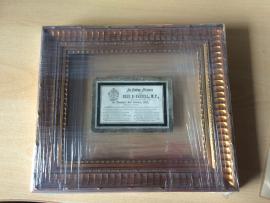
Framed. Reads: "In loving memory of Chas. S. Parnell, M.P., who departed this life on Tuesday, 6th October, 1891, aged 46 years, and was interred at Glasnevin Cemetery, Sunday, October 11th, 1891."

LMOD
IE LMOD 1360 · Item · Twentieth Century

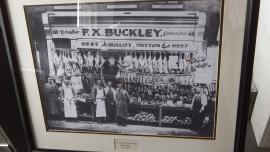
Original Black and White Photograph
Black Frame& mounted
This photo is a donation from Frank Buckley, son of the original FX Buckley.

It depicts the FX Buckley butchers on Moore Street. There would have been a dozen butchers on Moore Street; today there are 2. Francis Xavier Buckley is in the middle of the photo with a white coat and a dark apron. Francis was named after the Francis Xavier Church in Gardiner Street. Castle Catholics, his siblings were called John, Mary, William, Edward and Margaret.

Buckley's family came to Dublin from Buckleigh in Wales in the 17th century. They were butchers from the day they arrived, with premises in City Markets, Bull Alley, Patrick Street, Queen Street and, eventually, Moore Street.

Note the price of a sirloin roast, 6 pence a pound, which is roughly 10 cents a pound in today's money; less than a hundredth of what it would cost today.

On the far right of the picture you can see Tommy Mulvaney. What used to be called a confirmed bachelor, Tommy doted on FX, and worked in the shop he was in his late 70s. When FX said you can't be working here every day at your age, he said, "Oh Mr Buckley you can't be telling me not to come in," so they agreed that he would come in only on Fridays and Saturdays. Tommy had a few trinkets, such as a gold watch and tiepin, all of which were left to Mr Buckley upon his death. He was, says Frank, a lonely man for whom this shop was his life.

LMOD
IE LMOD 2388 · Item · Twentieth Century

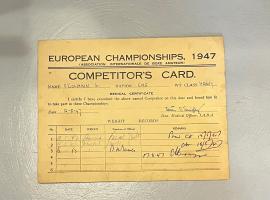
Competitor's Card of Gearóid O'Colmáin for the European Heavyweight Boxing Championships in 1947

LMOD
IE LMOD 2389 · Item · Twentieth Century

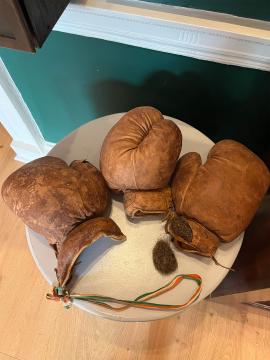
Boxing Gloves worn by Gearóid O'Colmáin when he won the Heavyweight Boxing European Championship in 1947.
"The Fighting Farrier"
One of Ireland's greatest boxers, Gerry ó Colmáin attributed his strength to working in the family forge on Camden Place, where he made horseshoes. "The hard work on the anvil was worth more than all the workouts, sparring sessions and roadwork you could get."
This fighting farrier represented Ireland at the 1947 European Championships. In the final, Ó Colmáin floored the English favourite George Scriven with a punch that burst his glove. As a result, he ended up boxing with three gloves, which you can see here. Gerry Ó Colmáin remains the only Irish heavyweight to win a European title.

LMOD