A black and white photograph of Dublin Football Club with the caption above 'Under the Auspices of the Butchers Social Union. Winners Metropolitan Cup, 1928-9. Leinster Senior League Champ, 1929-30.' and the names of the people in the photograph below. This black and white photograph features the Dolphin Football Club team. Based in Dolphin’s Barn, they won the Metropolitan Cup and the Leinster Senior League, and played most of their home games in Tolka Park.
LMODPink ticket for a balcony seat in the Gaiety for 20 January 1930.
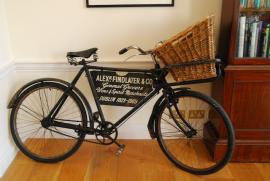
LMODBlack 1930s bicycle with wicker basket. Text 'Alex Findlater and Co. General Grocers Wine and Spirit Merchants, Dublin 1823 - 1969' on side of bike. Small wooden plaque on basket with text 'Alex Findlater & Co Ltd, A.I. Old Irish Whiskey, Trade AI Mark, Dublin, Rathmines, Blackrock, Kingston, Sandymount and Howth'
Alex Findlater and Co. started life in 1823, trading whiskey, wine and beer. The company expanded rapidly, adding general groceries to its alcohol trade, and became a major institution, with branches all over the city. This delivery bicycle was used by the company in the 1930s. (It was also used to launch the first annual Bloomsday Messenger Bike Rally in 1993.) Ultimately, pressure from supermarkets became too much for Findlaters’ more traditional service – as William Findlater had predicted at a 1902 staff meeting: “This brings up the question of packet goods, which is one of the curses of the trade, unless they bear our own brand. If this is encouraged much further it will mean the passing out of the grocer, and he will be replaced by a mere hander-out of packet goods, or, we will have nothing but girls behind our counters, which may be unpleasant to many of the young men present!”
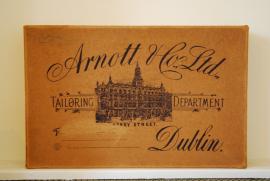
Cardboard box with picture of Arnotts on Henry Street and words 'Arnott and Co Ltd. Tailoring Department Henry Street, Dublin' Can also be dated 1949.
Established at 15 Henry Street in 1843, Arnotts was for many years the largest department store in Dublin. Patrick Pearse allegedly stopped off to settle his account on his way to the GPO on the day of the Rising. In recent years the store has become a prominent victim of the recession.
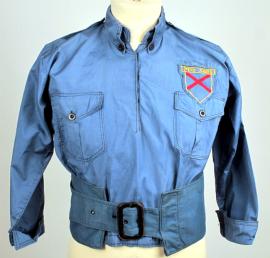
LMOD/uniform shirt and belt of Irish Comrades Association or 'Blueshirts'
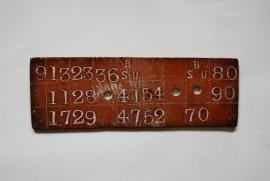
LMODLr Gardiner St. Possibly 1930s – regularly stolen to heel shoes so holes were put in to stop that. Brown with numbers evenly spaced and with 3 holes. Also has initials BSU on it twice.
In the 1930s the Butchers Social Union found themselves faced with a mystery. Their leather bingo cards kept going missing. One day someone noticed that bingo players were stealing the cards to patch holes in their shoes. So the Union decided to stamp several holes in the cards, thus foiling the thieves.
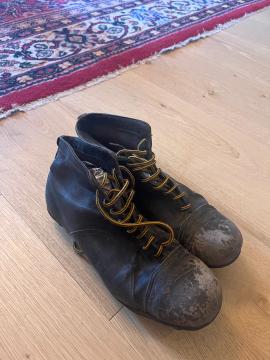
LMODPair o 1930s Dublin Leather Football boots featuring original molded rubber studs.
LMODA poster for the ESB with a drawing of a woman relaxing in her home encouraging potential customers to switch to electricity by describing how it will make their life easier. Can be dated 1929.
It is arguable that the most positive decision made by the new Free State government was to build the Shannon Scheme. The project cost £5.5 million, which was about 20% of the government day to day expenditure at that time, and it involved the construction of Ardnacrusha Power Station. Critics of the scheme said it would be a White Elephant as the demand for electricity would never be sufficient to justify the project costs. They were wrong. There was a huge growth in electricity sales from 43kWh hours in 1930 to 218kWh hours in 1937. ESB’s first showroom at 25 St. Stephens Green was part of the success story. Opening in 1929, it sold £315.6sh.8d worth of electrical equipment in its first week of business.
LMODPoster for Fianna Fáil's national collection to help fund the party. The collection was held at local churches and the notice lists some of the things the party hopes to achieve such as 'the international recognition of the Sovereign Independence of Ireland' and 'abolition of the foreign imposed partition of the country'.
LMODA metal printing plate for Jameson whiskey which says 'The quality of John Jamerson three star whiskey is the same the wide world over' in mirrored writing. Can also be dated 1900s.
Dublin is indefatigably proud of its reputation as a boozy town. Jameson whiskey was first made here in 1780, when a distillery opened on Bow Street. This plate was used for printing advertisements. It assures readers that “The quality of John Jameson Three Star whiskey is the same the wide world over.”
LMOD