Sepia toned photograph of Olympia A.F.C. with the caption 'Winners: Leinster Senior Cup, Leinster Junior Cup, and Chichester Memorial Shield.' with the names of the people in the photograph below.
LMODPoster that says Sinn Fein and The Others, declaring who voted for independence and who remained loyalists
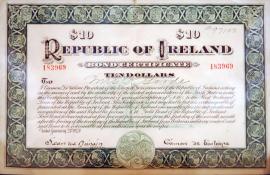
LMODA green and black Republic of Ireland bond certificate for ten dollars dated January 21 1920 with the printed signatures of Eamon de Bhailéara (Éamon De Valera) President, and Seán ua Núnáin, registrar and numbered in red 183969.
During the year and a half he spent crisscrossing the United States, Éamon de Valera used ‘republican bonds’ as a method of fundraising. Raising close to $6 million, the bonds were powerful tools, legitimising the Irish Republic in the eyes of people at home and abroad. However, after the Civil War the issue of whom the money belonged to would prove contentious. This $10 bond is dated January 21st 1920 and was issued to a Mrs. Goode.
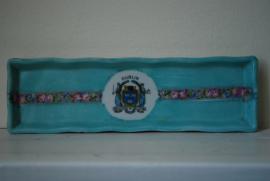
LMODLight blue with floral design strip pin tray that has the Dublin Crest in the centre with the motto ‘Obedientia Civium Urbis Felicitas’
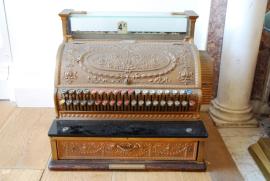
LMODBrass/bronze cash register on wooden base that was used in Findlater's stores. It has predecimalisation numers.
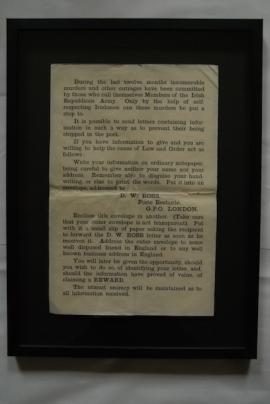
LMODInstruction notice for how to secretly and safely communicate information about the IRA by addressing a letter to D. W. Ross and sending it hidden in another envelope to a trusted friend or business in Britain.
LMODBlack print of James Connolly in ICA uniform standing in front of soldiers by Harry Kernoff.
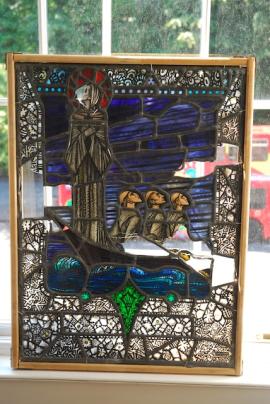
LMODReligious stain glass window by Harry Clarke depicting a saint, possibly St Brendan, standing looking one way and 3 monks kneeling looking in other direction in a boat on water.
Harry Clarke was Ireland’s pre-eminent stained-glass artist. His religious works are renowned for emulating the spirit of Irish medieval manuscript illumination. In his secular designs the Dubliner experimented with innovative new techniques, culminating in his masterpiece ‘The eve of St Agnes’ (1923-24). Clarke’s work was commissioned throughout Ireland and also in Australia and the United States. You can see his stained-glass windows in Bewley’s Café (1927), around the corner from the museum.
LMODLetter dated 7 October 1921, appointing Arthur Griffith, Michael Collins, Robert C Barton, Edmund J Duggan and George Gavan Duffy as Envoy Plenipotentiaries in both English and Irish (the Irish copy is embossed with the seal of the president) signed by Éamon De Valera. Also a list of instructions and rules for the plenipotentiary team.
This is the most important historical document in the museum. Appointing Dáil Éireann’s delegation for the Anglo-Irish Treaty negotiations, it includes signed instructions from Éamon de Valera, who had recently been chosen as Dáil President by his colleagues. It is one of five original copies, and for 40 years the document languished at the back of a filing cabinet in a law firm on Ormond Quay. The exact role and powers of the plenipotentiaries would be disputed in the bitter debate that surrounded the Dáil’s ratification of the Treaty.
A black and white photograph of people arriving for Michael Collins funeral at Glasnevin on 28 August 1922 by Independent Newspapers PLC. The first man on the left is Mr. J. Fitzgerald-Kennedy, the first Minister for Justice in the Provisional Government.
LMOD