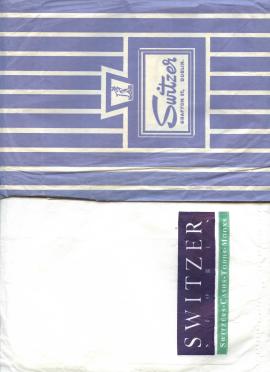
Three blue and white striped paper bags from Switzers, one white paper bag with blue Swtizers logo
Sin títuloNonfiction, throughout history, historic Ireland, music, anthology, paperback, CD.
Sin títuloA black and white photograph showing a number of children outside a tenement house on Henrietta Street.
Throughout the first half of the century, nearly a third of Dublin’s population lived in overcrowded tenements. The tenement system had its origins in the middle of the 19th Century, when Dublin saw an influx of people from the countryside in the wake of the Famine. In the words of archaeologist and historian Christiaan Corlett, “a Dublin solution was found to a Dublin problem,” when many fine Georgian residences were converted to house far more people than they were originally designed to accommodate. In 1913 John Cooke presented his pictorial account of the city’s slums to the Dublin Housing Inquiry. The photographs now form part of the archive of the Royal Society of Antiquaries of Ireland. They represent a grim and highly vivid account of the slum conditions at that time.
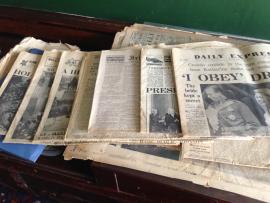
Sin títuloNewspaper originals, various (June 8th 1959, Nov 14th 1951, Nov 26th 1963, June 26th 1959, Jan 27th 1954) Other originals Irish Press Nov 5th 1958, Irish Press June 26th 1959, Irish Independent May 17th 1940, Jan 2nd 1935 special tribute to William Martin Murphy, Daily Express June 9th 1961
Sin títuloA black and white photograph of people at the Irish International Exhibition in Herbert Park 1907 by J. J. Clarke.
Sin títuloA black and white photograph of inside George's Arcade showing shop fronts and two cars parked inside.
The George’s Street Arcade was the first purpose-built shopping centre in Dublin. The current building dates from 1894, after the original was destroyed in a fire. The market was initially unpopular with Dubliners, as neither local architects nor builders were employed, and no Dublin dignitaries were invited to the opening ceremony. A wave of public sympathy for the stallholders followed the fire, and part of the rebuilding costs were paid for by public subscription. Today, fortune tellers, record shops and body piercing studios have taken the place of electrical factors and paper shops. (It remains home to one of Dublin’s great literary retreats, Stokes Books.)
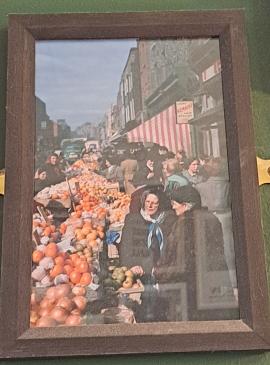
Sin títuloA colour photograph of fruit and veg stalls with seller and pedestrians at a Dublin market. A general view of market stalls selling fruit and vegetables in Dublin, Ireland circa 1950.
Sin títuloThis stool was made with a shutter from 11 Harcourt Terrace. The shutter is marked by bullet holes from the 1916 Rising. In 2011 James Carroll hand-crafted the stool in his workshop in the Wicklow mountains, using cleft ash. Carroll uses materials often discarded or passed over by others, bringing the pieces to life with traditional Irish craftsmanship.
Sin títuloA black and white photograph of people arriving for Michael Collins funeral at Glasnevin on 28 August 1922 by Independent Newspapers PLC. The first man on the left is Mr. J. Fitzgerald-Kennedy, the first Minister for Justice in the Provisional Government.
Sin títuloAn Ireland football team jersey signed by the team.
Sin título