Nonfiction, historic Ireland, 1900s, newspaper, quote, photography, illustration, culture, politics, hardback
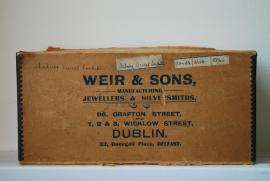
Sem títuloCardboard Weir and Sons box with dark blue writing ‘Weir and Sons manufacturing Jewellers and Silversmiths. 96 Grafton Street and 1, 2 and 3 Wicklow Street, Dublin. 33 Donegal Place, Belfast.’ Also has two stickers with items ‘Silver Sweet Baskets’ and ‘Candle stick tops’ written on them.
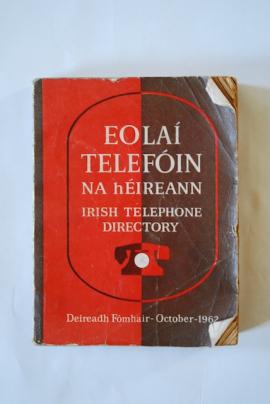
Sem títuloPhone directory with brown and red cover with white writing. ‘Eolaí Telefóin na hÉireann Irish Telephone Directory Deireadh Fómhair – October – 1962
This small telephone directory covers the whole of the Republic of Ireland – and less than half the book is devoted to phone numbers outside of Dublin. The first pages contain instructions on using a phone, with advice like ‘replace receiver before re-dialling,’ and ‘speak directly into the transmitter.’ There was no standard emergency number in those days – it is 999, 9999, 10 or 0, depending on the user’s location.
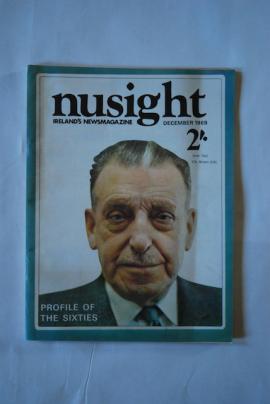
Sem títuloNusight magazine dated December 1969 with headline ‘Profile of the Sixties’ and a picture of Sean Lemass.
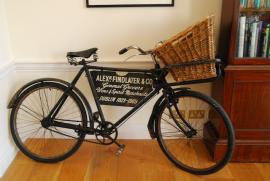
Sem títuloBlack 1930s bicycle with wicker basket. Text 'Alex Findlater and Co. General Grocers Wine and Spirit Merchants, Dublin 1823 - 1969' on side of bike. Small wooden plaque on basket with text 'Alex Findlater & Co Ltd, A.I. Old Irish Whiskey, Trade AI Mark, Dublin, Rathmines, Blackrock, Kingston, Sandymount and Howth'
Alex Findlater and Co. started life in 1823, trading whiskey, wine and beer. The company expanded rapidly, adding general groceries to its alcohol trade, and became a major institution, with branches all over the city. This delivery bicycle was used by the company in the 1930s. (It was also used to launch the first annual Bloomsday Messenger Bike Rally in 1993.) Ultimately, pressure from supermarkets became too much for Findlaters’ more traditional service – as William Findlater had predicted at a 1902 staff meeting: “This brings up the question of packet goods, which is one of the curses of the trade, unless they bear our own brand. If this is encouraged much further it will mean the passing out of the grocer, and he will be replaced by a mere hander-out of packet goods, or, we will have nothing but girls behind our counters, which may be unpleasant to many of the young men present!”
Partially coloured map of Dublin Port and the Liffey from Eden Quay and O'Connell Street out to sea. 'Dublin Harbour Plan of Shipping Quays, Sheds and Tramways Under the Jurisdiction of the Dublin Port and Docks Board 1951'
Dublin was a port before it was a city. This map shows the quays, sheds and tramways under the jurisdiction of the Dublin Port and Docks Board in 1951. At the time, ships unloaded much further up the Liffey – the port moved downstream with the advent of larger container ships.
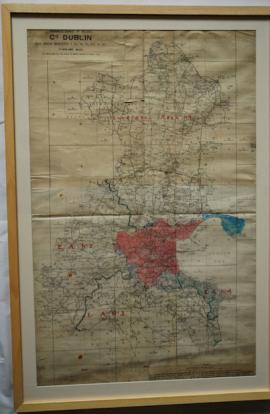
The map shows whole of Dublin and electoral areas. Ordnance Survey of Ireland, Co Dublin
Sem títuloCelebrating A Thousand Years with special design of castle on the front.
Dublin Corporation decided to celebrate Dublin’s millennium in 1988. This bottle is an iconic souvenir of that year. You’ll find one of these bottles in a Dubliner’s attic.
Black print of James Connolly in ICA uniform standing in front of soldiers by Harry Kernoff.
Sem título1922-1923 black and white photo of an anti-Treaty fighter pointing a gun at a Free State soldier in uniform mounted on backing.
This photo was taken during the Civil War. It shows an Irregular soldier in plain clothes capturing a Free State soldier in uniform. The photo was used by the Anti-Treaty side for propaganda purposes and was probably staged.