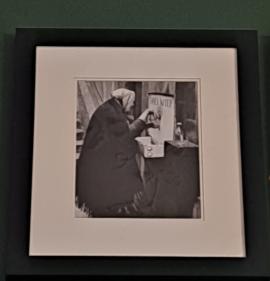
A print of a black and white photograph of an elderly woman collecting holy water from a tap on Meath Street taken by Bill Doyle.
Sans titreBlack and white photograph of Francis Bacon taken by John Minihan in London in 1976 with the written caption ‘Francis Bacon was born in Dublin in 1909, he died in Madrid, Spain in 1992. Bacon was one of the most important painters of the twentieth century. I first met the artist in the early 70s and would photograph him in London and Paris. Bacon worked with photographs, many of his friends were photographers.’
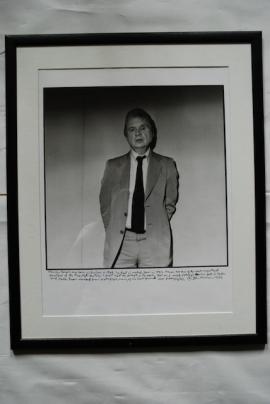
Francis Bacon was born up the road on Baggot Street. But like many other Dubliners – from Edmund Burke to Brendan Bracken – he saw himself as an Englishman. This photograph of Bacon was taken by John Minihan in 1976. Bacon’s paintings were famously bleak and emotionally raw. Margaret Thatcher once called him “that man who paints those dreadful pictures.”
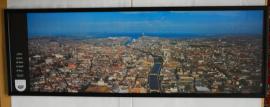
A poster of a panoramic photograph over looking Dublin City taken for the European City of Culture, 1991 with the quote ‘... from swerve of shore to bend of bay ...’ Finnegan’s Wake by James Joyce.
This photo commemorates Dublin’s reign as European City of Culture in 1991. The Scottish Ballet came over to symbolically hand over the title from Glasgow, and there was a 31-hour reading of Ulysses on the radio.
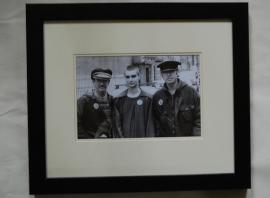
A print of a black and white photograph of Sinéad O’Connor taken in 1995 with two Lock Hards by Bill Doyle.
Lock-hards were a fixture of Dublin life for decades. They would shout unsolicited parking advice, hoping for a fee. Peaked caps lent them a spurious air of authority. Sinéad O’Connor is an Irish singer who won fame with her cover of Prince’s ‘Nothing Compares 2U’. She has often been a figure of controversy, expressing strong views on organised religion and women’s rights, most famously tearing up a picture of Pope John Paul II on US television. A Dubliner is someone who loves to remind you that Sinead O’Connor once worked as a waitress in the Bad Ass Café.
fiction, historic Ireland, 1800s, music, culture, entertainment, anthology, hardback
Sans titrenonfiction, historic Ireland, 1800s, 1900s, sport, hardback
Sans titrefiction, historic Ireland, 1900s, novel, humour, paperback
Sans titreDisplay case of stuffed animals including a red squirrel, owl, magpie and others.
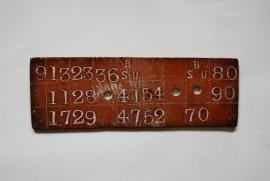
Sans titreLr Gardiner St. Possibly 1930s – regularly stolen to heel shoes so holes were put in to stop that. Brown with numbers evenly spaced and with 3 holes. Also has initials BSU on it twice.
In the 1930s the Butchers Social Union found themselves faced with a mystery. Their leather bingo cards kept going missing. One day someone noticed that bingo players were stealing the cards to patch holes in their shoes. So the Union decided to stamp several holes in the cards, thus foiling the thieves.
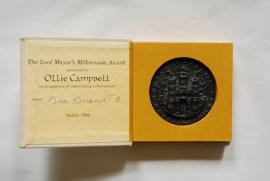
Sans titreThe Dublin City Seal from the thirteenth century, the earliest item in the City Regalia, gifted in a special presentation book to Ollie Campbell by the Lord Mayor Ben Briscoe. ‘The city is portrayed at peace by a ship at sail in a sea of plenty; on the obverse the city gates are shown under siege with two sentries sounding the alarm, while two archers take aim with their crossbows. On the city walls to heralds also sound the alarm, and on the gates in the foreground are impaled the heads of three offenders as a dire warning’ ‘Stamped around the rim on both sides are the words “Sigillum Commune Dublinie” or “The Common Seal of the City of Dublin”’ The presentation box itself is signed by Ben Briscoe and has a picture of the Mansion House on the cover.
Sans titre