Showing 2108 results

Archival description
1018 results with digital objects Show results with digital objects
IE LMOD 253 · Item · Twentieth Century

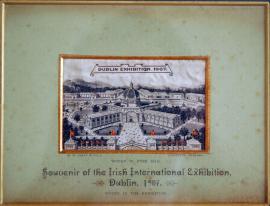
2 pictures woven at the exhibition. The first of a Dublin scene in black and white with red details, gold trimming and bordered by green. The second of of O'Connell (Sackville) Street and Bridge in black and white with gold trimming and bordered by green.
The Irish International Exhibition was the key social event of the first decade. It was hosted on the grounds of Herbert Park in Ballsbridge between May and November of 1907. The aim was to promote domestic industry by showcasing Irish products, as well as encouraging the development of commercial links by inviting all countries to exhibit their goods. Nearly three million visitors came to ogle at everything from industrial machinery to fine art, but the main attraction was a full-scale Somali village and the rare whimsy of a water chute and switchback railway. One of these pictures shows the central exhibition hall; the other captures a scene from O’Connell Bridge.
LMOD
IE LMOD 679 · Item · Twentieth Century

A sepia toned picture of the St. Laurence's Football Club. Captioned above 'Winners of Athletic Union League and J. W. Elvery Cup. Season 1906-07.' with the names of those in the photograph listed below.

LMOD
IE LMOD 559 · Item · Twentieth Century

A programme for 'As You Like It' at the Theatre Royal, Dublin in 1908. Green cover with white writing.

LMOD
1910 Route Map of Dublin
IE LMOD 332 · Item · Twentieth Century

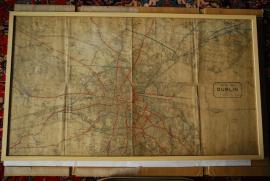
Map of Dublin with main routes around the city coloured in red and blue.

LMOD
1910 Scoil Éanna Prospectus
IE LMOD 445 · Item · Twentieth Century

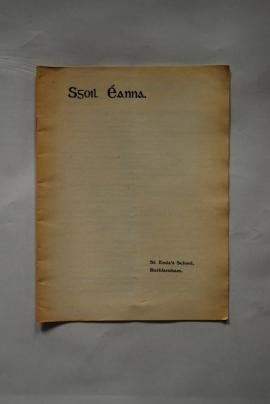
Prospectus for St. Enda’s School, Rathfarnham for year 1910 – 1911 Head Master Pádraig Pearse

This school prospectus encapsulates the two great loves of P.H. Pearse’s life: education and the Irish l anguage. Greatly encouraged by the example of Belgian schools, in 1908 Pearse founded Scoil Éanna in Ranelagh, a bilingual school for boys, followed shortly in 1910 by a girls’ school, Scoil Íde. As well as teaching through both Irish and English, Pearse pursued and pioneered a child-centred approach to education. His 1912 collection of essays, The Murder Machine, was an indictment of the British education system, placing Pearse at the forefront of educational innovation.

LMOD
IE LMOD 444 · Item · Twentieth Century

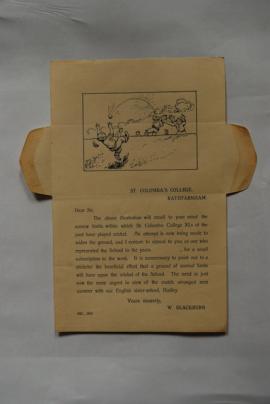
A letter with illustrations asking former student and cricket player to help fund the widening of the cricket pitch. Dated December 1910.

Just up the road from Patrick Pearse’s school, Scoil Éanna, there was a protestant boarding school, St. Columba’s College, where the aim was to furnish the sons of the landed gentry with a decent education. Here the college appeals to old boys for a few quid to widen the cricket pitch, a need that is all the greater in view of the upcoming game against sister school Radley.

LMOD
1910s Dolphin's Barn Brick
IE LMOD 481 · Item · Twentieth Century

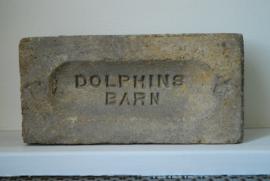
A grey brick from the Dolphin's Barn birckworks.

The Dolphin’s Barn Brick and Tile Company was established in 1900, and bricks with the Dolphin’s Barn stamp were used widely throughout the city between 1900 and 1942. The distinctive yellowish colour of the bricks means there is a tendency to describe all bricks of a similar colour as ‘Dolphin’s Barn’ bricks, even ones that were produced long before the factory opened. The company was a major employer, and its bricks were used in many notable buildings around Dublin, including the GMB in Trinity College, Steevens’ Hospital and the National Gallery of Ireland. The company merged with the Mount Argus works and the Rathnew Brick Company in 1921. It ceased operation in 1942.

LMOD
1910s HMS Dublin Flag
IE LMOD 596 · Item · Twentieth Century

A navy blue flag with the British flag, a Union Jack, in the top left corner that was the ensign on the HMS Dublin. Can also be dated 1927.

The Battle of Jutland was one of the key naval engagements of the First World War. HMS Dublin played a part in the battle, which was fought in 1916. The ship had been adopted by a committee of Dublin citizens and businessmen who raised funds to provide it with a band and other amenities. When the ship was decommissioned in 1926, Dublin Chamber of Commerce was presented with its battle-scarred ensign – complete with Union Jack – and in turn the Chamber donated it to Christ Church, since when it has languished, unseen, in the cathedral crypt.

LMOD
1910s Poems by P. H. Pearse
IE LMOD 266 · Item · Twentieth Century

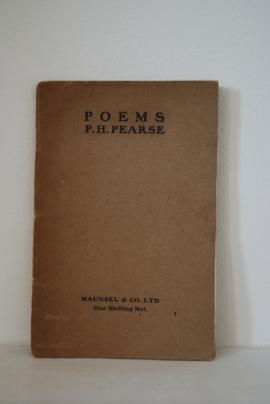
Books of poems by Pádraig Pearse and printed Maunsel and co Ltd. fiction, historic Ireland, 1900s, poetry, nationalism, paperback

LMOD
IE LMOD 268 · Item · Twentieth Century

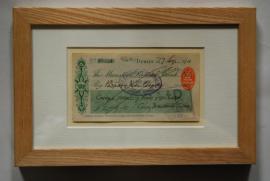
Cheque for amount of £4-9-0. Dublin 27 September 1911, The Munster and Leinster Bank Ltd., stamped in The Royal Bank of Ireland, Terenure Branch on 30 September 1911
This cheque for four pounds and nine shillings was paid to Pádraig Mac Piarais, future President of the Provisional Government of the Irish Republic, who signed the reverse side in both Irish and English. This small piece of paper highlights the common misnomer of ‘Pádraig Pearse’. A central figure in the Irish Language revival movement, Pearse practiced linguistic dichotomy. It was either Pádraig Mac Piarais or P.H. Pearse, never a mongrel of the two.

LMOD