Boxing Gloves worn by Gearóid O'Colmáin when he won the Heavyweight Boxing European Championship in 1947.
"The Fighting Farrier"
One of Ireland's greatest boxers, Gerry ó Colmáin attributed his strength to working in the family forge on Camden Place, where he made horseshoes. "The hard work on the anvil was worth more than all the workouts, sparring sessions and roadwork you could get."
This fighting farrier represented Ireland at the 1947 European Championships. In the final, Ó Colmáin floored the English favourite George Scriven with a punch that burst his glove. As a result, he ended up boxing with three gloves, which you can see here. Gerry Ó Colmáin remains the only Irish heavyweight to win a European title.
Vintage tennis racket from Elvery's of Dublin and Cork, frame around head of racket
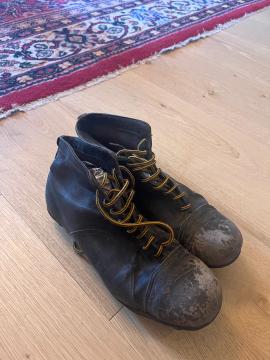
Sem títuloPair o 1930s Dublin Leather Football boots featuring original molded rubber studs.
Sem títuloIn white frame
Sem títuloA volunteer pass for the 2003 Special Olympic Assistant Gymnastics Awards
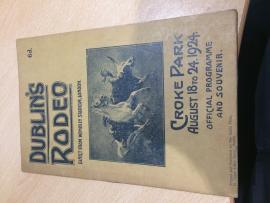
Sem títuloProgramme for Dublin's Rodeo 1924. "Dublin's Rodeo, direct from Wembley Stadium, Dublin". Croke Park, August 18th to 24th, 1924.
Sem títuloA black and white photograph of Dublin Football Club with the caption above 'Under the Auspices of the Butchers Social Union. Winners Metropolitan Cup, 1928-9. Leinster Senior League Champ, 1929-30.' and the names of the people in the photograph below. This black and white photograph features the Dolphin Football Club team. Based in Dolphin’s Barn, they won the Metropolitan Cup and the Leinster Senior League, and played most of their home games in Tolka Park.
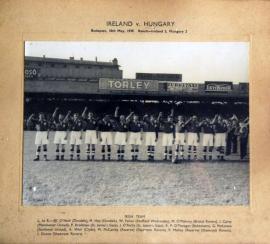
Sem títuloA black and white photograph of the Irish team on the pitch. Captioned above 'Ireland v. Hungary Budapest, 18th May, 1939. Result - Ireland 2, Hungary 2.' with a list of player underneath the picture.
At first glance it looks as if the Irish soccer team is giving a fascist salute in this picture, which was taken in Budapest. In 1939, Hungary was ruled by a right-wing dictator, and was close to Germany and Italy. But Hungary was not fascist, and while it did have a fascist movement, it was a threat to the ruling regime, and was actually banned in 1939. Some members of that movement, the Arrow Cross, did use a closed-fist salute (the classic fascist salute was open-handed) but the truth is probably more innocuous. Three cheers for Hungary?
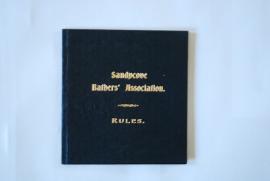
Sem títuloGreen cover with gold writing ‘Sandycove Bathers’ Association Rules Book’ Set of 19 rules dated 29 May 1907
Sem título