Showing 2102 results

Archival description
1012 results with digital objects Show results with digital objects
IE LMOD 342 · Item · Twentieth Century

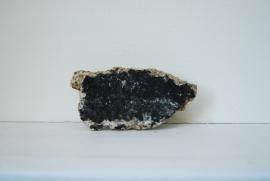
A piece of rock from Nelson's Pillar from after it was blown up in 1966.

This piece of granite is from Nelson’s Pillar on O’Connell Street, which was blown up by the IRA at 2am on 8 March 1966. Bombs destroyed the upper half of the pillar and threw the statue of Nelson into the street. Several days later, the Irish army demolished the remains of the pillar, causing more damage to O’Connell Street than the original blast. Nelson’s head was stored in a shed on Clanbrassil Street, before being stolen by students from the National College of Art and Design as a fund-raising prank. It was leased to a London antique store owner, and later appeared on the stage of the Olympia when the Dubliners performed. The head of Nelson’s Pillar is now on display in the excellent Dublin City Library and Archive on Pearse Street.

LMOD
IE LMOD 731 · Item · Twentieth Century

This piece of granite is alleged to be from Nelson's Pillar on O'Connell Street, which was blown up by the IRA at 2am on 8 March 1966. Bombs destroyed the upper half of the pillar, causing more damage to O'Connell Street than the original blast. Nelson's head was stored in a shed on Clanbrassil Street, before being stolen by students from the National College of Art and Design as a fund raising prank. It was leased to a London antique store owner, and later appeared on the stage of the Olympia when the Dubliners performed. The head of Nelson's Pillar is now on display in the excellent Dublin City Library and Archive on Pearse Street.

LMOD
IE LMOD 655 · Item · Twentieth Century

Two black and white photographs of the Liffey and the surrounding docklands from above.
McMahon recreated the photos as faithfully as possible, using the same exposure settings, in the same locations – even at the same time of day and in the same weather. In the photo on the left the shadows on the Custom House – the large domed building in the foreground – are in the exact same position. Almost everything else has changed.

LMOD
1967 Coinage of Ireland
IE LMOD 527 · Item · Twentieth Century

A set of 5 Irish coins from the year 1967 in a display.

  1. Silver six pence coin with a dog.
  2. Copper halfpenny coin with a pig and piglets.
  3. Silver half crown coin with a horse.
  4. Silver three pence coin with a hare.
  5. Copper penny coin with a turkey.

This is a set of Irish coins from soon before the currency was decimalised in 1971. The coins on display are a six pence coin (with a picture of a dog), a half penny (a pig and piglets), a half crown (two and a half shillings, or thirty pence, with a picture of a horse), three pence (a hare) and a penny, with a picture of a turkey.

LMOD
IE LMOD 526 · Item · Twentieth Century

A red piece of material with a tasseled bottom with 'Royal Dublin Society HorseShow 1967' and 'Judge' written on it in gold on a black background.

LMOD
IE LMOD 290 · Item · Twentieth Century

Colour picture of the destruction of Fitzwilliam Street dated 1967 when the ESB were building on the street.
Michael Byrne’s painting of ‘Derelict Dublin’ shows the destruction of Fitzwilliam Street in 1967, as the ESB knocked down several houses to build a new headquarters. Until then it had been the longest uninterrupted stretch of Georgian architecture in the world.

LMOD
IE LMOD 283 · Item · Twentieth Century

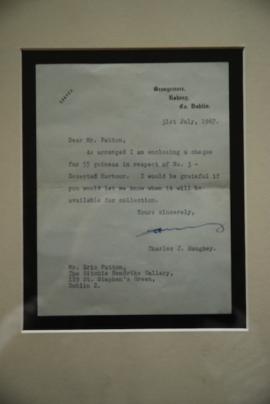
Letter dated 31 July 1967 from Haughey to Eric Patton discussing a payment of 55 guineas.
Charles Haughey was Minister for Finance at the time he wrote this letter to Eric Patton, from the Richie Hendriks Gallery. While the gallery, which was here on Stephen’s Green, was cutting-edge, the painting in question recently sold for just €800. In the same year, Haughey sold his old house in Raheny for £200,000, having bought it for £50,000 ten years earlier. The land had been rezoned in the interim. Opening an office building on St Stephen’s Green that year, he announced, “I, for one, have never believed that all architectural taste and building excellence ceased automatically with the passing of the18th Century.” That same year, 1967, Haughey bought Abbeville, an eighteenth century mansion designed by Gandon.

LMOD
1967 Wanderly Wagon
IE LMOD 549 · Item · Twentieth Century

The wagon from the RTÉ children's television show 'Wanderly Wagon'

This model of the Wanderly Wagon was used for the flying scenes in the RTE children’s programme. (The wheels have been repaired with Lego.) Wanderly Wagon ran from 1967 until 1982, and it was a beloved part of many an Irish childhood. The central role of O’Brien was played by the legendary puppeteer Eugene Lambert, who travelled the country in his flying wagon. O’Brien was joined by characters such as the grumpy Fortycoats, the lovable Godmother (played by Nora O’Mahoney) a flying dog called Judge, and old Mr Crow, a rather sardonic and unlikable bird. Strange but true: Neil Jordan once wrote an episode of Wanderly Wagon.

LMOD