10 postcards, pictures of 1916 leaders and events, and JFK at Arbour Hill
LMODPoster. Quote from Lord Kitchener - 'Be honest with yourself. Be certain that your so-called reason is not a selfish excuse.'
Lord Horatio Herbert Kitchener, the iconic face of British army recruitment posters and Secretary of state for war, was born in County Kerry in 1850. Why should Irishmen fight for the English? Ulster Unionists saw it as an opportunity to showcase their loyalty to the Empire. The Nationalist community was divided, with Irish Parliamentary Party leader John Redmond encouraging Irishmen to join up and fight for Home Rule, while others saw “England’s difficulty as Ireland’s opportunity.”
A ball invitation to Captain L. Heuson M.V.O to meet the Lord Lieutenant and Countess of Aberdeen on Wednesday 18 June 1913 in the Pavilion, Kingstown. (Present day Dún Laoghaire)
John Campbell Hamilton-Gordon, Earl of Aberdeen, served as Lord Lieutenant of Ireland briefly in 1886 before returning to the post for a nine-year spell after five years as Governor General of Canada. The Countess of Aberdeen, Isobel Hamilton-Gordon, also left her mark, serving as president of the International Council of Women as well as founding the Victorian Order of Nurses. This invitation was sent to Captain Lionel Lloyd Hewson, a Member of the Royal Victorian Order.
LMODBlack and white but slightly green tinted photo of interior of a 1913 Dublin Tenement showing bed and table
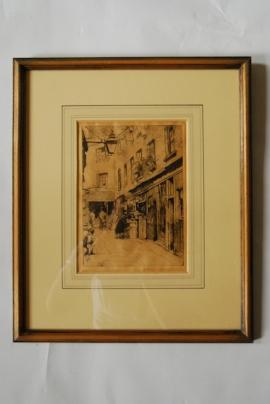
LMODEtching of Leinster Market (Off D'Olier St) by Estella Solomons HRHA, signed and dated 1913.
Many Dubliners lived in the sort of tenements depicted in this 1913 etching by Estella Solomons. Solomons was, like Harry Kernoff, Jewish. Her brother, Bethel, was master of the Rotunda Hospital. Estella studied art under Walter Osborne and William Orpen, and later married Seamus O’Sullivan, with whom she produced the Dublin Magazine for 35 years.
LMODBlack and white map of Dublin from 1912. Published by the Director at the Ordnance Survey Office, Phoenix Park, Dublin 1912.
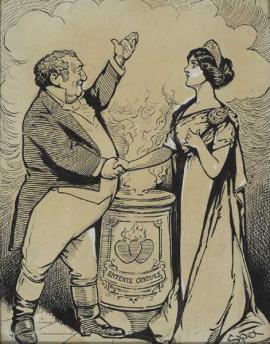
LMODA black and white picture with white highlights of John Bull (Britain) and Hibernia (Ireland) shaking hands circa 1912, signed in lower right corner.
This cartoon by John Fergus O’Hea shows John Bull (Britain) and Hibernia (Ireland) shaking hands in front of the burning fire of an Entente Cordiale. O’Hea, who worked under the pseudonym Spex, was one of the most prolific Irish political cartoonists of his time. The cartoon suggests that love is in the air, although Hibernia seems a little unsure.
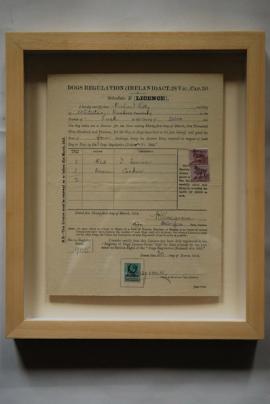
A stamped license for 2 dogs under the ‘Dogs Regulation (Ireland) Act, 1865’ dated 30 March 1912.
From the minutely-detailed collie on the stamps to the requirement for the clerk to sign the form in two separate places, this Dog Licence is no simple record of payment. It is a monument to the fusty bureaucracy of the British Empire.
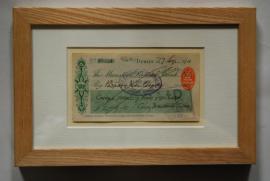
LMODCheque for amount of £4-9-0. Dublin 27 September 1911, The Munster and Leinster Bank Ltd., stamped in The Royal Bank of Ireland, Terenure Branch on 30 September 1911
This cheque for four pounds and nine shillings was paid to Pádraig Mac Piarais, future President of the Provisional Government of the Irish Republic, who signed the reverse side in both Irish and English. This small piece of paper highlights the common misnomer of ‘Pádraig Pearse’. A central figure in the Irish Language revival movement, Pearse practiced linguistic dichotomy. It was either Pádraig Mac Piarais or P.H. Pearse, never a mongrel of the two.
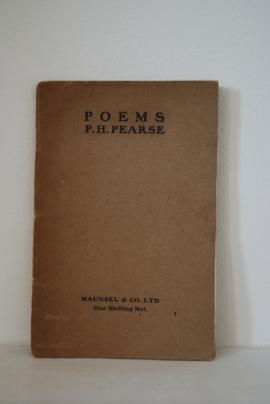
Books of poems by Pádraig Pearse and printed Maunsel and co Ltd. fiction, historic Ireland, 1900s, poetry, nationalism, paperback
LMOD