Framed full bottle of Findlater's Invalid Stout with a red and green label.
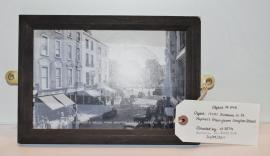
LMODA black and white photograph of the Fusilier's Arch entrance into St. Stephen's Green taken from Grafton Street. 'Entrance to St. Stephen's Green from Grafton Street, Dublin. VR. 1677.' written on the picture itself along the bottom.
LMODA wooden box for Bells Dyers and Cleaners, Rathmines Road, Dublin. Gives the addresses of multiple locations in Dublin.
LMODContains tea. Alex Findlater & Co Ltd. Tea Blenders Dublin, Blend of specially selected Indian tea
LMOD‘Bombs Fall in Counties Dublin and Monaghan’ Page 5 from the Irish Independent, Saturday December 21, 1940 detailing the Dublin and Monaghan bombings by aircraft with photos of the damage as well as other stories relating to World War 2.
During ‘The Emergency’ Ireland suffered occasional bombings from German aircraftHere the Irish Independent details the events of December 20th 1940 when unidentified aircraft dropped bombs on Counties Dublin and Monaghan.
LMODA black and white photograph from Independent Newspaper PLC which shows people inspecting bomb damage to a home.
LMODA black and white photograph of Winston Churchill being followed by Brendan Braken out of 10 Downing Street by Central Press. With Braken's signature also in the bottom of the frame. From Getty 'Prime Minister Winston Churchill (1874 – 1965) leaves Downing Street in London with Irish journalist and Conservative politician Brendan Braken (1901 – 1958).'
Winston Churchill leaves 10 Downing Street with his ‘faithful chela,’ Brendan Bracken. One of the most mysterious Dubliners of the 20th Century, Bracken was an adventurer who tried to disguise his roots (Dublin/Tipperary), claiming instead to be Australian. A Tory MP at the age of 28, he published both the Economist and the Financial Times, and was loyal to Churchill when the latter had been cast into the political wilderness after the First World War. In 1940, when Ireland practiced scrupulous neutrality, Brendan Bracken played a key role in Churchill’s succession as Prime Minister, and went on to serve as Minister of Information for three years. Viscount Bracken died in 1958 at the age of 57. He is the subject of an excellent biography by fellow Dubliner Charles Lysaght.
LMODA black and white photograph of the Irish team on the pitch. Captioned above 'Ireland v. Hungary Budapest, 18th May, 1939. Result - Ireland 2, Hungary 2.' with a list of player underneath the picture.
At first glance it looks as if the Irish soccer team is giving a fascist salute in this picture, which was taken in Budapest. In 1939, Hungary was ruled by a right-wing dictator, and was close to Germany and Italy. But Hungary was not fascist, and while it did have a fascist movement, it was a threat to the ruling regime, and was actually banned in 1939. Some members of that movement, the Arrow Cross, did use a closed-fist salute (the classic fascist salute was open-handed) but the truth is probably more innocuous. Three cheers for Hungary?
LMODGas mask from the Emergency, with box, 1939. Black rubber face mask with transparent plastic eyepiece. Canvas straps with buckles to fasten over face. Number of stamps on mask. One stamp reads "Lot 176, SG and Co. 20 Dec 1939" Three other stamps on metal filter of mask - one reads "Civilian". In cardboard box stamped with large letter S on three sides - indicating small size mask. Text under lid has directions for packing and use of respirator. Name handwritten on top of box in pencil, Brendan.
LMODLarge London made gas mask made for the Emergency/World War 2. Has multiple stamps and markings including 'Home Office Certification', 'Lot 131 SG and Co 1 Dec 1939' 'LIC No. 1 6 Dec 1939'
Ireland chose to remain neutral in the Second World War, but there was still a fear that the country could be attacked. A state of emergency was declared (hence ‘the Emergency’), and gas masks like this were made widely available.
LMOD