Showing 2102 results

Archival description
1012 results with digital objects Show results with digital objects
IE LMOD 1763 · Item · Twentieth Century

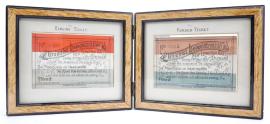
A ticket for the Unionist Demonstration, New Leinster Hall, Dublin, Tuesday, 29 November, 1887, in a folding frame with a forged version of the ticket.

The meeting was addressed by the Marquess of Hartington, later 8th Duke of Devonshire' whose younger brother Lord Frederick Cavendish had been murdered in the Phoenix Park in 1886.
The Irish Times Wednesday, November 30, 1887 reports that 'At the outset of the proceedings it became apparent that a small minority was present who had conceived the purpose of breaking up the proceedings. Forged tickets were printed and were freely offered for sale at the last moment. But the deception was clumsy. A few gained admission to the Hall and during the evening strove to create a disturbance.'

LMOD
1889 Parnell Commission
IE LMOD 1967 · Item · Twentieth Century

newspaper seller's billboard poster

LMOD
IE LMOD 369 · Item · Twentieth Century

Poster for public auction on Friday 29th of May, 1896 at No. 6 D'Olier Street by Mr Frank Hodgen. Houses being sold are No. 6 Summer Hill, No. 7 Summer Hill and No. 32 Clarence Street. Goes into the details of each property and prices.

LMOD
IE LMOD 487 · Item · Twentieth Century

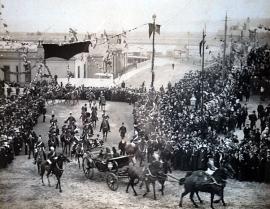
A black and white photo of Queen Victoria in her carriage traveling through Kingstown, currently Dún Laoghaire, surrounded by crowds during her visit to Ireland in 1900.

Queen Victoria visited Dublin in 1900, near the end of her long reign. She landed at Kingstown (now Dún Laoghaire) on April 4th. The streets were lined with delighted Dubliners, and Victoria arrived in ‘her’ city through mock-castellated gates on Leeson Street Bridge.

LMOD
1900s Henrietta Street
IE LMOD 767 · Item · Twentieth Century

A black and white photograph showing a number of children outside a tenement house on Henrietta Street.

Throughout the first half of the century, nearly a third of Dublin’s population lived in overcrowded tenements. The tenement system had its origins in the middle of the 19th Century, when Dublin saw an influx of people from the countryside in the wake of the Famine. In the words of archaeologist and historian Christiaan Corlett, “a Dublin solution was found to a Dublin problem,” when many fine Georgian residences were converted to house far more people than they were originally designed to accommodate. In 1913 John Cooke presented his pictorial account of the city’s slums to the Dublin Housing Inquiry. The photographs now form part of the archive of the Royal Society of Antiquaries of Ireland. They represent a grim and highly vivid account of the slum conditions at that time.

LMOD
IE LMOD 380 · Item · Twentieth Century

To be let for building. Apply Talbot Coall and Son, Kingstown.' White with blue writing.

Talbot, Coall and Son was an estate agent based in Dún Laoghaire, which was known as Kingstown until 1921. The firm was listed in the 1913 telephone directory at Kingstown 13. They once helped the family of J.M. Synge to buy a house in the area.

LMOD
IE LMOD 535 · Item · Twentieth Century

A glass lemonade bottle from the early 1900s with Thwaites Dublin in raised glass. Codd bottle with a glass marble and rubber ring.

LMOD