Showing 2082 results

Archival description
880 results with digital objects Show results with digital objects
1970s Sudocrem Tub
IE LMOD 564 · Item · Twentieth Century

330g semi clear tub with white lid of Sudocrem with label on front and back. 'Sudocrem antiseptic healing cream. For napkin rash, bedsores, surface wounds, sunburn, eczema, chilblains, acne, minor burns.

Believe it or not, Sudocrem was invented in Dublin in 1931 by a pharmacist, Thomas Smith. It was originally called “Smith’s Cream”.

LMOD
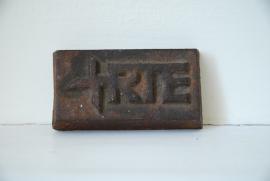
1970s RTÉ Stamp
IE LMOD 356 · Item · Twentieth Century

Metal block with raised outline of RTÉ and the St Bridget cross logo.

RTÉ has its origins in 1926, with the creation of 2RN, Ireland’s first radio station. The 1960 Broadcasting act changed its name to Radio Éireann, and made provisions for a new television channel, Telefís Éireann. The introduction of television in 1961 was a major catalyst for social change in Ireland, with imported British and American TV shows and home-grown content like the Late Late Show providing a platform for discussing taboo subjects like contraception and homosexuality.

LMOD
IE LMOD 294 · Item · Twentieth Century

Print of a colour photographic portrait of Charles Haughey taken during the 1970s by Colman Doyle
Charles Haughey’s career was chequered, and he lived rather well for a modest public servant. He was dismissed from the cabinet in 1970 along with Neil Blaney for allegedly conspiring to import arms into Northern Ireland for the IRA. Cleared of all criminal charges, Haughey fought to regain a seat in the cabinet, and later became party leader and Taoiseach.

LMOD
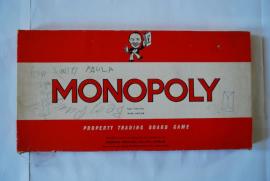
1970s Monopoly Irish Edition
IE LMOD 390 · Item · Twentieth Century

Irish Edition of the game Monopoly with board, money, cards, houses, playing pieces and instruction.

LMOD
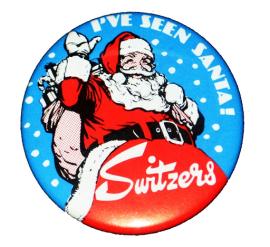
IE LMOD 524 · Item · Twentieth Century

I've Seen Santa' badge for Switzers with a picture of a waving Santa.

Switzer’s department store had the best in-house Santa Claus, and their Christmas window displays were a seasonal benison. With lights, music and animatronic puppets, people would make trips from all over the country just to visit this much-missed institution.

LMOD
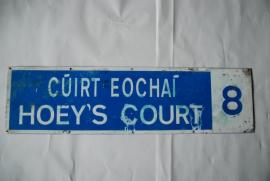
IE LMOD 404 · Item · Twentieth Century

Blue and white Dublin 8 street sign ‘Hoey’s Court’ ‘Cúirt Eochaí’

Hoey’s Court would mean nothing to the world, or indeed to Dubliners, except that Jonathan Swift was born here in 1667.

LMOD
IE LMOD 725 · Item · Twentieth Century

A silver poster with a black design of a woman in a circle for the nightclub Elizabeth on Lesson's Street. Can be dated 1969.

Elizabeth’s was Leeson Street’s first and most famous discotheque. Owned by colourful promoter and DJ Maurice Boland, it sparked an explosion of nightclubs on Leeson Street. The Elizabeth in question is Liz Willoughby, a prominent woman in Dublin at the time.

LMOD
IE LMOD 304 · Item · Twentieth Century

Red writing on white background poster for a charity collection. ‘On behalf of the deserving poor of Dublin’ ‘Support Dublin’s Oldest Charity’
Dublin’s oldest charity was founded in 1790 as The Charitable Society for the Relief of Sick and Indigent Roomkeepers of all Religious Persuasions in the City of Dublin. The founders were a group of concerned middle-class men – including a grocer, a schoolmaster and a linen-draper – who wanted to alleviate the poverty in Georgian Dublin long before any government social welfare schemes.

LMOD
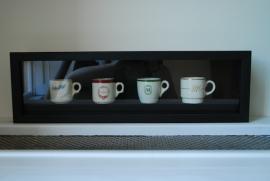
IE LMOD 372 · Item · Twentieth Century

1: Dolphin Hotel -Their logo in black on a white cup.
2:Royal Marine Hotel, Dún Laoghaire - White cup with wine coloured logo and a wine and gold stripe around the rim.
3: Metropolitan Hotel - White cup with a green M logo and a green stripe around the rim.
4: Royal Hibernia Hotel - White cup with RH logo in gold with a gold stripe around the rim.

  1. Dolphin Hotel. This fine Gothic building is on East Essex Street. It was later converted into Dublin District Court offices.
  2. Royal Marine Hotel. Originally the Hayes Royal Hotel (1828), the hotel was bought in 1863 by William Dargan, builder of the Kingstown Railway, and was rebuilt and reopened as the Royal Marine Hotel in 1865.
  3. The Metropole Hotel. During the 1916 Rising this hotel, adjacent to the GPO, was completely destroyed. The same site is now home to Penney’s clothing store.
  4. Royal Hibernian Hotel. Formerly located on Dawson Street, this grand old hotel was demolished in the 1980s to make way for the Royal Hibernian Way.
LMOD