Affichage de 2098 résultats

Description archivistique
924 résultats avec objets numériques Afficher les résultats avec des objets numériques
1970s Abbeville Honey Jar
IE LMOD 636 · Pièce · Twentieth Century

A small, round, off white, speckled clay honey pot with Abbeville Honey written on the front.

This jar reveals a largely undocumented passion of Charles J. Haughey. Throughout his life he was an avid beekeeper. Haughey collected honey from bees in Abbeville, his Georgian mansion in Kinsealy, and gave it to family and friends in jars such as this one – presented by his son, Seán, to the museum.

Sans titre
IE LMOD 646 · Pièce · Twentieth Century

Two bullets mounted on a sizable rock from Cullyhanna Graveyard in Armagh with 3 silver plaques bearing the words 'October 16th' 'Ben Dunne 1981' and 'October 22nd'. All of which is mounted on a wooden block.

On the 16th of October, 1981, Ben Dunne Jnr. was kidnapped by the IRA on his way to open a new Dunnes Store in Portadown. Before his release on the 22nd of October, two of his abductors gave him these bullets and told him that they could easily have been used – one on him and the other on Fr. Dermot McCarthy. Fr McCarthy had tried to secure Dunne’s release, making a plea on television and at one point meeting with Dunne’s kidnappers. McCarthy was nearly shot in crossfire. After his release, Ben Dunne mounted the bullets on a piece of stone from the cemetary in Armagh where he had been held captive.

Sans titre
IE LMOD 653 · Pièce · Twentieth Century

Two black and white photographs of the same part of Henry Street in 1966 and 2009. The left one has a bin with the caption 'Cleaner streets please' and the one on the right has a bin with the caption 'Litter is disgusting. So are those responsible.'

Sans titre
1980 Bagatelle Promo shot
IE LMOD 666 · Pièce · Twentieth Century

A black and white photograph of the band Bagatelle in front of a 46A bus.

Sans titre
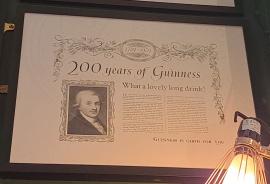
1959 Guinness Advertisement
IE LMOD 671 · Pièce · Twentieth Century

A black and white advertisement for Guinness titled '1759-1959 200 Years of Guinness' and numbered GD.1 the first Irish press advertisement for Guinness stout. It has a picture of Arthur Guinness on the left and some text describing a little of the development of Guinness.

Guinness advertising has been iconic for a long time, but most of the advertising now seen in pubs here was never used in Ireland. This is an original proof of the first print ad ever published in Dublin. GD1, as it is known, was produced in 1959 – the bicentenary of the company.

Sans titre
1982 Rolling Stones Slane Contract
IE LMOD 674 · Pièce · Twentieth Century

Typed letter June 1982 from Jim Aiken, Arnie Pustilnik and Andre Wilkinson in regards to the Rolling Stones playing Slane.
One of Jim Aiken’s first major coups was in persuading the Rolling Stones to play at Slane Castle in 1982. It was only the second time that Lord Henry Mountcharles had staged a large outdoor concert in his natural amphitheatre (Thin Lizzy had played there the previous year, supported by U2). These telex messages hashed out the agreement between the band and the Dublin-based concert promoter. The Rolling Stones would pay for the stage, lighting and support bands out of a $375,000 fee… plus a percentage of ticket sales.

Sans titre
IE LMOD 679 · Pièce · Twentieth Century

A sepia toned picture of the St. Laurence's Football Club. Captioned above 'Winners of Athletic Union League and J. W. Elvery Cup. Season 1906-07.' with the names of those in the photograph listed below.

Sans titre
1934 Pillar Cinema team
IE LMOD 698 · Pièce · Twentieth Century

A black and white photograph of the Pillar Cinema football team.

Dublin once had enough cinemas to organise their own football league. The Pillar Cinema’s team is pictured here in the Phoenix Park in front of the original pavilion for footballers. It was built in 1907, prompting an Evening Herald reporter to write: “I doubt whether any other city can beat Dublin for ground dressing accomodation for juniors. I refer to the new Phoenix Park pavilion which was opened last Saturday by his Excellency the Lord Lieutenant. His Excellency also referred to our GAA friends who will have their own pavilion soon, they have our good wishes for no matter what laws we play under we are all football people and thorough sportsmen at heart.”

Sans titre
IE LMOD 705 · Pièce · Twentieth Century

A black and white photograph of Winston Churchill being followed by Brendan Braken out of 10 Downing Street by Central Press. With Braken's signature also in the bottom of the frame. From Getty 'Prime Minister Winston Churchill (1874 – 1965) leaves Downing Street in London with Irish journalist and Conservative politician Brendan Braken (1901 – 1958).'

Winston Churchill leaves 10 Downing Street with his ‘faithful chela,’ Brendan Bracken. One of the most mysterious Dubliners of the 20th Century, Bracken was an adventurer who tried to disguise his roots (Dublin/Tipperary), claiming instead to be Australian. A Tory MP at the age of 28, he published both the Economist and the Financial Times, and was loyal to Churchill when the latter had been cast into the political wilderness after the First World War. In 1940, when Ireland practiced scrupulous neutrality, Brendan Bracken played a key role in Churchill’s succession as Prime Minister, and went on to serve as Minister of Information for three years. Viscount Bracken died in 1958 at the age of 57. He is the subject of an excellent biography by fellow Dubliner Charles Lysaght.

Sans titre