A print of a black and white photo showing people queueing, including some nuns, to see ‘Love Story’ at the Green Cinema on St. Stephen’s Green taken by Bill Doyle.
A queue for Love Story at the St Stephen’s Green Picture House (known as the Green) in 1971. Many nuns were not allowed to go to the theatre, but because films were censored, they were allowed to go to the cinema. The Green opened in 1935, one of the first to deviate from the lavish style of early cinemas, offering a more relaxed experience with less overbearing décor. The cinema survived until 1987.
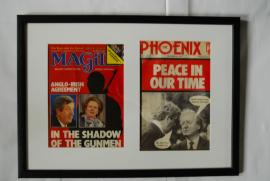
2 magazine covers from November 1985 framed together. First cover is Magill, November 14 1985 with the headline ‘Anglo Irish Agreement – In the Shadow of the Gunmen’ There are photos of Garrett Fitzgerald and Margaret Thatcher along with the silhouette of an armed man on the page background. The second cover is The Phoenix, Vol 3, No 23, November 22, 1985 with the headline ‘Peace in Our Time’ with captioned photos of Charles Haughey and Garret Fitzgerald saying ‘What’s Maggie doing about the extremists?’ ‘She didn’t even mention you.’
The Anglo-Irish Agreement was signed by Taoiseach Garret FitzGerald (‘Garret the Good’) and Margaret Thatcher on 15 November 1985, with the intention of creating peace in Northern Ireland. The Provisional IRA and loyalist paramilitaries rejected the agreement and continued fighting. Magill was a left-wing magazine founded by Vincent Browne in 1977. John Mulcahy’s Phoenix is an Irish Private Eye.
nonfiction, historic Ireland, 1900s, autobiography, music, politics, culture, paperback
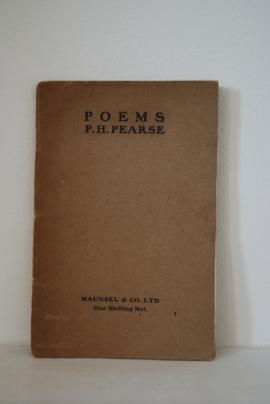
Sin títuloBooks of poems by Pádraig Pearse and printed Maunsel and co Ltd. fiction, historic Ireland, 1900s, poetry, nationalism, paperback
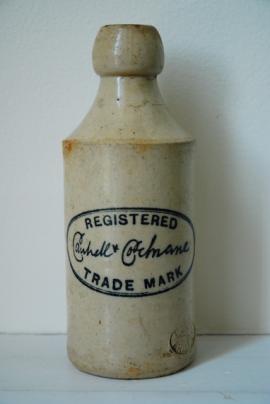
Sin títuloCantrell and Cochrane earthenware lemonade bottle containing lemonade, also stamped Price Bristol.
This unopened bottle of lemonade was found by David Casserly in the wreck of the RMS Leinster, in 1991/92, which was sunk by a German submarine in October 1918, two months before the end of the First World War. The greatest disaster in Irish maritime history, the loss of the mail boat off the coast of Dún Laoghaire took the lives of 501 people, including about 300 soliders and nurses returning to the front. The bottle was manufactured by Cantrell and Cochrane, better known as C&C. It was made in Bristol, by the Price stoneware company.
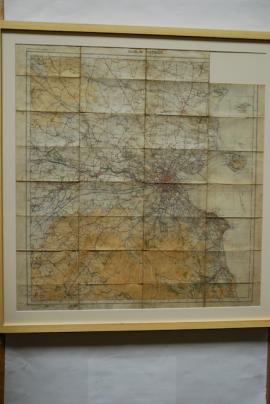
Ordnance Survey of Ireland (Third Edition) Map of Dublin. Some colour for roads, mountains, etc.
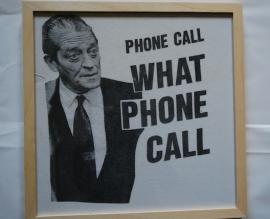
Sin títuloFramed tshirt of black and white picture of Brian Lenihan Snr with the caption 'Phone call, what phone call.'
This t-shirt mocks Brian Lenihan during the 1990 Presidential campaign. The aging statesman was caught spoofing in one of those classic Irish Presidential campaigns (long and bitter). With his credibility damaged, Lenihan lost the election to Mary Robinson.
Sin títuloEnvelope marked 'Most Important' and letter dated 1928 from Archbishop Edward Byrne to Chief Justice Hugh Kennedy about Catholics attending Trinity College.
In his letter to Chief Justice Hugh Kennedy, Archbishop of Dublin Edward Byrne reaffirms the Catholic Church’s prohibition on Catholics entering Trinity College Dublin. The Archbishop explains: “How the authorities of any Catholic school can, in the face of their conscientious obligations, encourage their pupils to risk their soul’s salvation in Trinity College is to me an absolutely insoluble puzzle.”
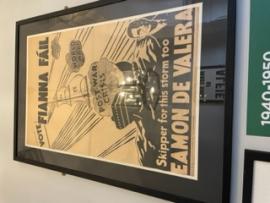
Black and white 'Vote Fianna Fáil' election poster with a drawing of a ship at sea with clouds containing the words 'Post war crisis' 'World war' and 'economic war'. 'Skipper for this storm too, Éamon De Valera'
Sin títuloPoster. For North West Dublin. Candidates: Breathnach (Cormac Ll. D.), Feehan (Matt. Lieut. Col.), Gogan (Richard (Dick)). 'Help De Valera Complete the Task'
Fianna Fáil had a tangled birth in the Civil War. Sinn Féin split into pro-and Anti-Treaty factions, with de Valera leading the Anti-Treaty faction. Anti-treaty Sinn Féin boycotted the Dáil for several years after the end of the Civil War until a faction around Éamon de Valera split and created Fianna Fáil. They first came to power in 1932 and were long the most popular party in Ireland. The 1948 election was controversial as Éamon de Valera introduced the Electoral Amendment Act, which was seen as an attempt to ensure the continued dominance of Fianna Fáil. But de Valera failed to retain power after the other parties joined together to create the first coalition government.