Affichage de 2088 résultats

Description archivistique
886 résultats avec objets numériques Afficher les résultats avec des objets numériques
1916 The Freeman's Journal
IE LMOD 376 · Pièce · Twentieth Century

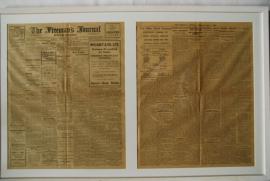
Framed pages 1 and 3 of The Freeman's Journal 9 May 1916. Has articles relating to the aftermath of the Easter Rising including information on executions, arrests, damage to property as well as articles about John Redmond and John Dillon. The Freeman's Journal - Special Edition Vol CXLXI Dublin Tuesday, May 9, 1916

This edition of the Freeman’s Journal lists the names of the four men executed the previous day, among them Michael Mallin who was in command of the garrison stationed across the road. It also gives the reaction of the British press, with the Manchester Guardian predicting: “Further executions can only create martyrs to refresh and renew the old bitterness between England and Ireland.”

Sans titre
1983 The Beano No. 2157 – Nov. 19th
IE LMOD 387 · Pièce · Twentieth Century

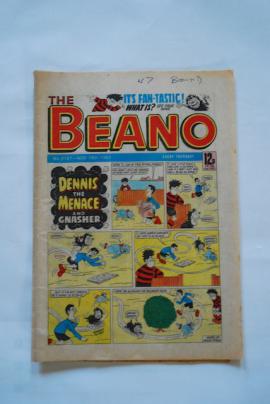
The Beano from November 1983 including colour and black and white strips such as ‘Dennis the Menance and Gnasher’, ‘Roger the Dodger’, ‘Minnie the Minx’, ‘Ball Boy’, ‘The Bash Street Kids’ and ‘Billy Whizz’.

Sans titre
1920s Dublin Pin Tray
IE LMOD 399 · Pièce · Twentieth Century

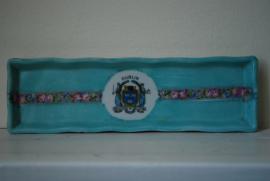
Light blue with floral design strip pin tray that has the Dublin Crest in the centre with the motto ‘Obedientia Civium Urbis Felicitas’

Sans titre
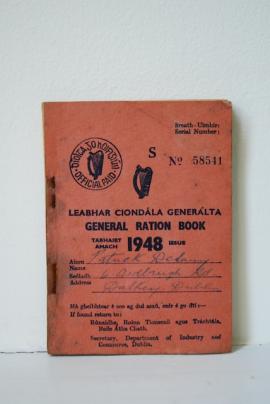
1948 Ration Book
IE LMOD 408 · Pièce · Twentieth Century

Pink General Ration Book 1948 issue. Serial number: 58541. Name: Patrick Delany. Address: 6 Ardbrugh Road, Dalkey, Dublin

During the ‘Emergency’ the Free State had a rationing system like that in Great Britain. Sugar, tea, butter, margarine, bread, flour and clothing were among the many items for which ration tickets were required. Poor families were hardest hit by the restrictions as bread was a central part of their diet. The most unpopular figure at the time was not Minister for Supplies Seán ‘half-ounce’ Lemass, but the notorious ‘glimmer man’ who went door-to-door to ensure that citizens were not using gas after hours.

Sans titre
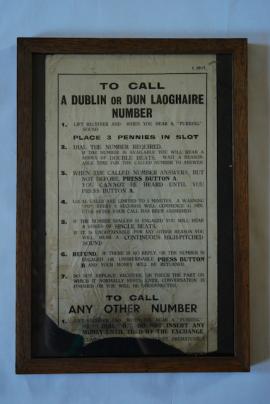
1940s Telephone Instructions
IE LMOD 413 · Pièce · Twentieth Century

Sign with instructions on how to call a Dublin or Dún Laoghaire phone number. The sign explains 7 step by step instructions in how to make a phone call. It also gives instructions on how to call elsewhere.

Sans titre
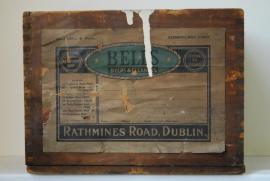
1940s Bells Dyers and Cleaners Box
IE LMOD 415 · Pièce · Twentieth Century

A wooden box for Bells Dyers and Cleaners, Rathmines Road, Dublin. Gives the addresses of multiple locations in Dublin.

Sans titre
IE LMOD 416 · Pièce · Twentieth Century

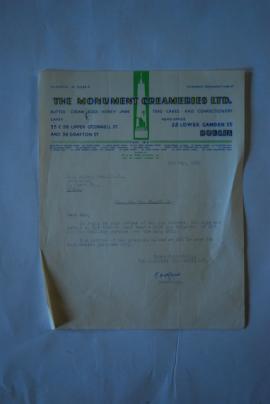
Letter headed letter from The Monument Creameries Ltd dated 4 May 1950 in regards to 46 Upper Baggot St and the valuation of the property.

Sans titre
1960s O'Connell Street by Coleman Doyle
IE LMOD 292 · Pièce · Twentieth Century

Colour photograph of O’Connell Street showing the GPO and Nelson’s Pillar as well as cars parked along the centre of the street taken by Colman Doyle.
This photograph shows the GPO on O’Connell Street. In 1966 the IRA blew up Nelson’s pillar, also pictured, and the Spire is now on the site that the pillar once occupied.

Sans titre
1971 St. Stephen's Green by Bill Doyle
IE LMOD 297 · Pièce · Twentieth Century

A print of a black and white photo showing people queueing, including some nuns, to see ‘Love Story’ at the Green Cinema on St. Stephen’s Green taken by Bill Doyle.
A queue for Love Story at the St Stephen’s Green Picture House (known as the Green) in 1971. Many nuns were not allowed to go to the theatre, but because films were censored, they were allowed to go to the cinema. The Green opened in 1935, one of the first to deviate from the lavish style of early cinemas, offering a more relaxed experience with less overbearing décor. The cinema survived until 1987.

Sans titre
IE LMOD 300 · Pièce · Twentieth Century

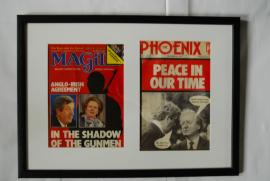
2 magazine covers from November 1985 framed together. First cover is Magill, November 14 1985 with the headline ‘Anglo Irish Agreement – In the Shadow of the Gunmen’ There are photos of Garrett Fitzgerald and Margaret Thatcher along with the silhouette of an armed man on the page background. The second cover is The Phoenix, Vol 3, No 23, November 22, 1985 with the headline ‘Peace in Our Time’ with captioned photos of Charles Haughey and Garret Fitzgerald saying ‘What’s Maggie doing about the extremists?’ ‘She didn’t even mention you.’
The Anglo-Irish Agreement was signed by Taoiseach Garret FitzGerald (‘Garret the Good’) and Margaret Thatcher on 15 November 1985, with the intention of creating peace in Northern Ireland. The Provisional IRA and loyalist paramilitaries rejected the agreement and continued fighting. Magill was a left-wing magazine founded by Vincent Browne in 1977. John Mulcahy’s Phoenix is an Irish Private Eye.

Sans titre