Showing 2082 results

Archivistische beschrijving
880 results with digital objects Show results with digital objects
IE LMOD 319 · Stuk · Twentieth Century

nonfiction, historic Ireland, 1900s, contemporary Ireland, 2000s, culture, politics, economy, Northern Ireland, hardback

Zonder titel
IE LMOD 283 · Stuk · Twentieth Century

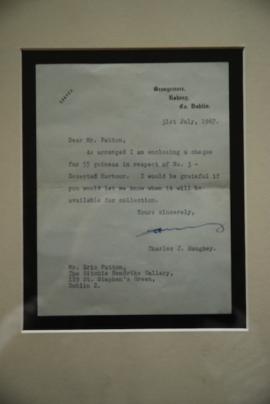
Letter dated 31 July 1967 from Haughey to Eric Patton discussing a payment of 55 guineas.
Charles Haughey was Minister for Finance at the time he wrote this letter to Eric Patton, from the Richie Hendriks Gallery. While the gallery, which was here on Stephen’s Green, was cutting-edge, the painting in question recently sold for just €800. In the same year, Haughey sold his old house in Raheny for £200,000, having bought it for £50,000 ten years earlier. The land had been rezoned in the interim. Opening an office building on St Stephen’s Green that year, he announced, “I, for one, have never believed that all architectural taste and building excellence ceased automatically with the passing of the18th Century.” That same year, 1967, Haughey bought Abbeville, an eighteenth century mansion designed by Gandon.

Zonder titel
Funeral Ledger
IE LMOD 287 · Stuk · Twentieth Century

Nichols of Lombard Street Funeral Ledger No. 32 which includes Jack B Yeats
This ledger from Nichols Undertakers records the details for the funeral of the painter Jack B. Yeats, who began his career as an illustrator before moving into expressionist and symbolist-influenced oil paintings. Yeats died in 1957, and was buried in Mount Jerome cemetery after a service in St. Stephen’s Church on Mount Street Crescent. He was buried in a silk-lined chestnut coffin, and his funeral cost £53 19s and 6d.

Zonder titel
IE LMOD 4 · Stuk · Twentieth Century

Poster. Quote from Lord Kitchener - 'Be honest with yourself. Be certain that your so-called reason is not a selfish excuse.'
Lord Horatio Herbert Kitchener, the iconic face of British army recruitment posters and Secretary of state for war, was born in County Kerry in 1850. Why should Irishmen fight for the English? Ulster Unionists saw it as an opportunity to showcase their loyalty to the Empire. The Nationalist community was divided, with Irish Parliamentary Party leader John Redmond encouraging Irishmen to join up and fight for Home Rule, while others saw “England’s difficulty as Ireland’s opportunity.”

Zonder titel
IE LMOD 7 · Stuk · Twentieth Century

Handwritten list of deceased by Senior Surviving Officers of the Garrison filed under headings 'Executed', 'Killed in Action', 'Died from Wounds', and 'Died in After Years' signed by Richard Mac Cormick, Capt. ICA. Includes Madam Markievicz.
Michael Mallin’s garrison of 200 men was camped across the road in the Green during the Rising. (Countess Markiewicz was his second-in-command.) The square was surrounded by high buildings, which made the rebels easy targets for the British forces. Each morning both sides halted fire in order to let the ducks in the Green be fed. Eventually the rebels were forced to retreat to the Royal College of Surgeons on the other side of the Green. The casualties are remembered on this gory souvenir placard from the 1940s; as you can see, Mallin was executed for his part in the Rising.

Zonder titel
IE LMOD 253 · Stuk · Twentieth Century

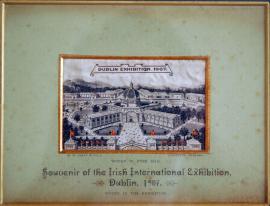
2 pictures woven at the exhibition. The first of a Dublin scene in black and white with red details, gold trimming and bordered by green. The second of of O'Connell (Sackville) Street and Bridge in black and white with gold trimming and bordered by green.
The Irish International Exhibition was the key social event of the first decade. It was hosted on the grounds of Herbert Park in Ballsbridge between May and November of 1907. The aim was to promote domestic industry by showcasing Irish products, as well as encouraging the development of commercial links by inviting all countries to exhibit their goods. Nearly three million visitors came to ogle at everything from industrial machinery to fine art, but the main attraction was a full-scale Somali village and the rare whimsy of a water chute and switchback railway. One of these pictures shows the central exhibition hall; the other captures a scene from O’Connell Bridge.

Zonder titel
IE LMOD 411 · Stuk · Twentieth Century

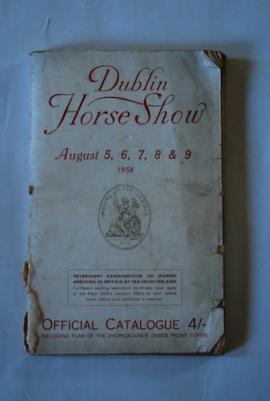
Book with white cover and red writing. ‘Dublin Horse Show August 5, 6, 7, 8 and 9 1958’ The cover also has the RDS logo.

Zonder titel