Wooden grip test with display showing strength of grip in ounces as well as two small displays with list of average grip strength by profession and lights
LMODPlastic pocket of letters and envelopes
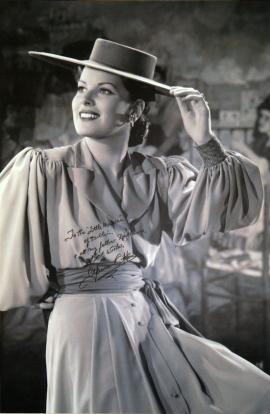
LMODA black and white photograph of Maureen O'Hara signed by her with 'To the "Litle Museum" of Dublin, + all my fellow Dubliners, Best Wishes, Maureen O'Hara'
The great Maureen O’Hara, star of The Quiet Man and Miracle on 34th Street, was born in Ranelagh in 1920. Now aged 91, she lives in Glengarriff in Cork. O’Hara trained as an actor at the Abbey Theatre and the Ena Mary Burke School of Drama and Elocution in Dublin. Her father owned shares in Shamrock Rovers F.C. and she remains a fan.
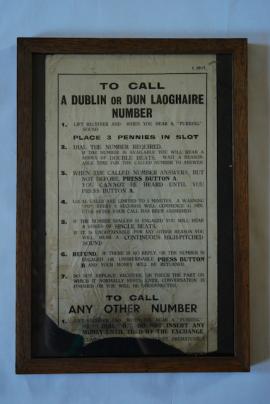
LMODSign with instructions on how to call a Dublin or Dún Laoghaire phone number. The sign explains 7 step by step instructions in how to make a phone call. It also gives instructions on how to call elsewhere.
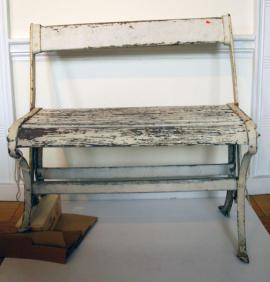
LMODWhite Dublin tram seat. One leg is shorter than the other due to where the engine/wheel used to be. The seat back can be moved.
One day Dublin will have a tram service as efficient as the last one was when we started to close it down. In the meantime we are left to admire this seat. At the end of the line, the back-rest was simply turned to face the other way.
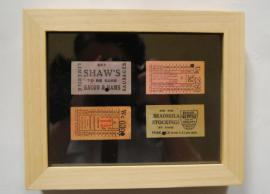
- Orange: Wc 0394, 1 1/2D. Ad on back for Flanagan's Ltd.
2.Blue: Sm 9924, 2D. Ad on back for Flanagan's and advertisement rates.
3: Purple: Rk 9313, 2D. Ad on back for Shaws. - Pink: Uq 2280, 3d. Ad on back for Newtonsandes Creamery.
5: Grey/Green: Yk 7755, 2 1/2d. Ad on back for Bradmola Stockings.
6: Grey/Blue: Rp 1642, 2d. Ad on back for Lombardstown Creamery.
The tramways began operating in 1872 and the very last line closed in 1959. The last tram in the city proper left Nelson’s Pillar in 1949. The tram barely made it, as the Irish Times reported: “Tram No. 252, the last one, had struggled free from the clutches of thousands of souvenir hunters in Westmoreland Street and had set out for Blackrock; two hours later it crawled into its home depot. The tram’s seats were gone, windows smashed, side panelling ripped away, still accompanied by a roaring, singing, hooting crowd, which had to be forcibly restrained by police reinforcements from breaking into the Blackrock depot.”
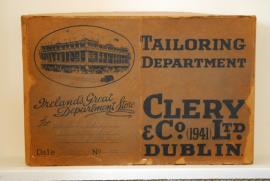
LMODCardboard box from Clery's with a picture of the store and the captions 'Ireland's Greatest Department Store' 'Tailoring Department' 'Clery and Co.(1941) Ltd. Dublin'
A box from Clery’s tailoring department in 1941. Clery’s was founded as ‘The New or Palatial Mart’ in 1853, bought over and renamed by M. J. Clery in 1883. The current building – which is modelled on Selfridge’s of London – dates from 1922, the original having been destroyed during the Easter Rising. In 1943, this much-loved department store was taken over by the Guiney family, who also owned the nearby Guiney’s department store.
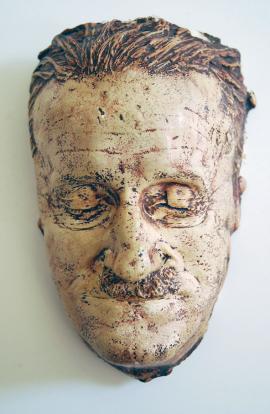
LMODWhite and brown coloured cast of the death mask of James Joyce. Has a protective latex cover.
On 11 January 1941, James Joyce – who was 58 years old – underwent surgery for a perforated ulcer in a Zurich hospital. The following day he fell into a coma, before waking, briefly, and calling for his wife and children. They were still on their way to the hospital when he died 15 minutes later. While two senior Irish diplomats were apparently in Switzerland at the time, neither attended Joyce’s funeral, and the Irish government subsequently declined Nora Joyce’s offer to permit the repatriation of his remains. This facsimile of Joyce’s death mask commemorates our greatest novelist.
LMODA black and white photograph of group of children on the street, many of them bare foot. From Getty: Children hanging around the Dolphin door begging for money and food.
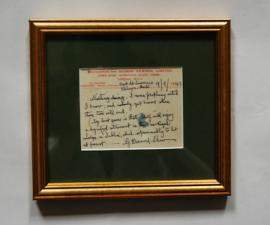
LMODReply to being asked when he thinks World War 2 will end. Jokes about Adolf Hitler retiring to Vice Royal Lodge, Dublin.
In 1943 the playwright George Bernard Shaw was living in London. Shaw went to school here on St. Stephen’s Green, and never lost his accent, even though he left Dublin at 20. A magazine called The Strand asked a number of writers when they thought the Second World War would end. “Nothing doing,” Shaw writes here, “I never prophesy until I know; and nobody yet knows where those two will end. My best guess is that Adolf will enjoy a dignified retirement in the Vice-Regal Lodge in Dublin, which is presumably to let at present.”