Sign with instructions on how to call a Dublin or Dún Laoghaire phone number. The sign explains 7 step by step instructions in how to make a phone call. It also gives instructions on how to call elsewhere.
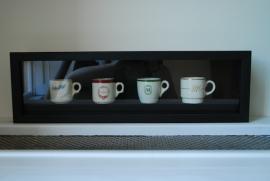
LMOD1: Dolphin Hotel -Their logo in black on a white cup.
2:Royal Marine Hotel, Dún Laoghaire - White cup with wine coloured logo and a wine and gold stripe around the rim.
3: Metropolitan Hotel - White cup with a green M logo and a green stripe around the rim.
4: Royal Hibernia Hotel - White cup with RH logo in gold with a gold stripe around the rim.
- Dolphin Hotel. This fine Gothic building is on East Essex Street. It was later converted into Dublin District Court offices.
- Royal Marine Hotel. Originally the Hayes Royal Hotel (1828), the hotel was bought in 1863 by William Dargan, builder of the Kingstown Railway, and was rebuilt and reopened as the Royal Marine Hotel in 1865.
- The Metropole Hotel. During the 1916 Rising this hotel, adjacent to the GPO, was completely destroyed. The same site is now home to Penney’s clothing store.
- Royal Hibernian Hotel. Formerly located on Dawson Street, this grand old hotel was demolished in the 1980s to make way for the Royal Hibernian Way.
Collection of 6 Telecom Éireann Call Cards from the 1990s
1: Commemorative Dublin Cultural Capital of Europe 1991 showing drawings of four Irish writers Oscar Wilde, Seán O’Casey, James Joyce and George Bernard Shaw. 50 units.
2: Photo of the Long Room in Trinity College Dublin commemorating Trinity’s 400 year anniversary. 50 units.
3: Photo of the Irish football team for the USA World Cup ’94. The back of the card also gives the details of each Ireland match in the first group stage. 10 units.
4: Picture of the roof of the Capitol Building backed by the American flag. ‘Celebrating President Clinton’s historic visit to Ireland, 1995’ 50 units.
5: Photo of a younger hand passing a cup and saucer of tea to older hands. ‘Reach out, Be a good neighbour, Be aware! Care!’ On the back in green writing is also ‘Reach out Your elderly or vulnerable neighbour living alone may need your help! Keep in touch’. 20 units.
6: Photo of Boyzone for Boyzone magazine. 10 units.
Between the era of the payphone and the mobile phone, there was a brief interlude in which the “cardphone” prospered. Telephone companies were keen to promote the cards - because customers paid up front, and often didn’t use their full allocation of credit. (Although an urban myth about recharging the cards by leaving them in your freezer was widely circulated). Small, iconic and fairly durable, these callcards quickly became a collector’s item among schoolboys, philatelists and miscellaneous geeks - traded at market stalls. Phone companies quickly realised they could capitalise on this by selling advertising space on the cards, creating even more collectables in the process. Most payphones in the city were converted to accept callcards. However, the rising ubiquity of mobile/cell phones soon ended the market for callcards.
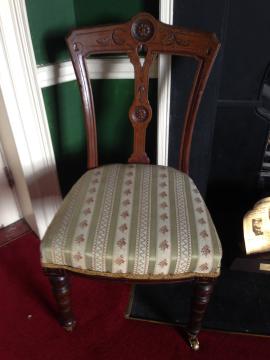
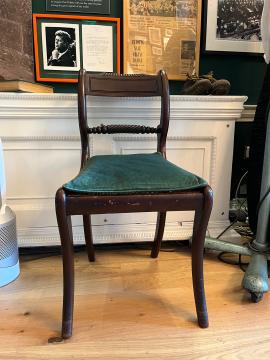
LMODAntique Georgian wooden chair with wicker seats and green pillow
LMODA rare original early 20th-century (c. 1900-1920) antique metal enamel advertising tray/ashtray for Cantrell & Cochrane Ginger Ale.
Vibrant green enamel with bold black lettering for "Cantrell & Cochrane's Ginger Ale".
Reverse is stamped with the maker/agent mark "W.E. Till, Dublin, 11, Dame Street".
LMODvarious matchboxes from around Dublin
LMODLarge hand painted ceramic cows head vase, black and white with pink nose
LMODMeasuring tape which belonged to Dr. James Hanlon, with beads sewn on for each inch, and a stich at each quarter of an inch.
LMODWatch with braille face. Written numbers with braille dots around the edge, face opens with button. Brown leather strap. Spectacles round.
LMOD