Showing 1012 results

Archival description
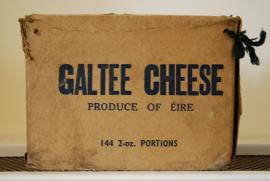
1940s Galtee Cheese Box
IE LMOD 492 · Item · Twentieth Century

Cardboard box for 'Galtee Cheese Product of Éire'

LMOD
IE LMOD 499 · Item · Twentieth Century

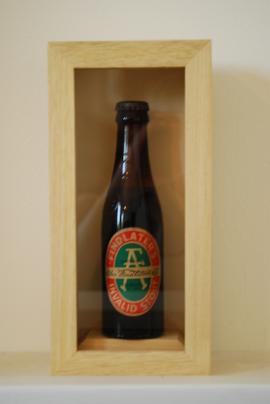
Framed full bottle of Findlater's Invalid Stout with a red and green label.

LMOD
IE LMOD 642 · Item · Twentieth Century

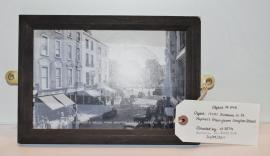
A black and white photograph of the Fusilier's Arch entrance into St. Stephen's Green taken from Grafton Street. 'Entrance to St. Stephen's Green from Grafton Street, Dublin. VR. 1677.' written on the picture itself along the bottom.

LMOD
IE LMOD 415 · Item · Twentieth Century

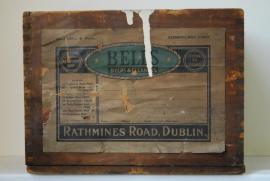
A wooden box for Bells Dyers and Cleaners, Rathmines Road, Dublin. Gives the addresses of multiple locations in Dublin.

LMOD
IE LMOD 265 · Item · Twentieth Century

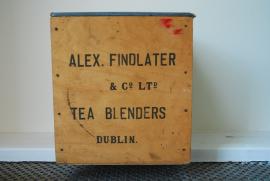
Contains tea. Alex Findlater & Co Ltd. Tea Blenders Dublin, Blend of specially selected Indian tea

LMOD
1940 Irish Independent
IE LMOD 446 · Item · Twentieth Century

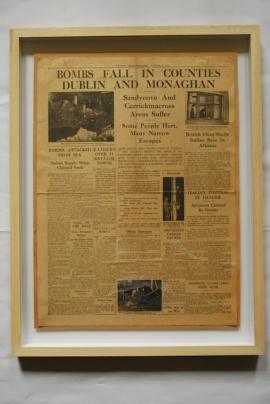
‘Bombs Fall in Counties Dublin and Monaghan’ Page 5 from the Irish Independent, Saturday December 21, 1940 detailing the Dublin and Monaghan bombings by aircraft with photos of the damage as well as other stories relating to World War 2.

During ‘The Emergency’ Ireland suffered occasional bombings from German aircraftHere the Irish Independent details the events of December 20th 1940 when unidentified aircraft dropped bombs on Counties Dublin and Monaghan.

LMOD
1939 Ireland v Hungary
IE LMOD 683 · Item · Twentieth Century

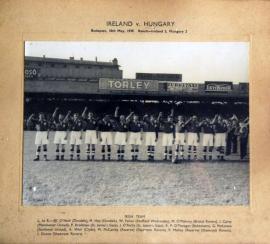
A black and white photograph of the Irish team on the pitch. Captioned above 'Ireland v. Hungary Budapest, 18th May, 1939. Result - Ireland 2, Hungary 2.' with a list of player underneath the picture.

At first glance it looks as if the Irish soccer team is giving a fascist salute in this picture, which was taken in Budapest. In 1939, Hungary was ruled by a right-wing dictator, and was close to Germany and Italy. But Hungary was not fascist, and while it did have a fascist movement, it was a threat to the ruling regime, and was actually banned in 1939. Some members of that movement, the Arrow Cross, did use a closed-fist salute (the classic fascist salute was open-handed) but the truth is probably more innocuous. Three cheers for Hungary?

LMOD
IE LMOD 852 · Item · Twentieth Century

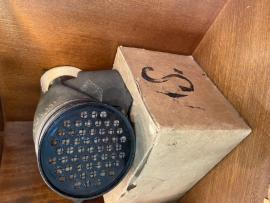
Gas mask from the Emergency, with box, 1939. Black rubber face mask with transparent plastic eyepiece. Canvas straps with buckles to fasten over face. Number of stamps on mask. One stamp reads "Lot 176, SG and Co. 20 Dec 1939" Three other stamps on metal filter of mask - one reads "Civilian". In cardboard box stamped with large letter S on three sides - indicating small size mask. Text under lid has directions for packing and use of respirator. Name handwritten on top of box in pencil, Brendan.

LMOD
1939 Emergency Gas Mask
IE LMOD 354 · Item · Twentieth Century

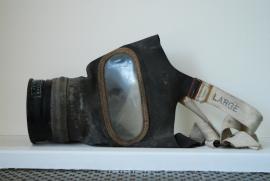
Large London made gas mask made for the Emergency/World War 2. Has multiple stamps and markings including 'Home Office Certification', 'Lot 131 SG and Co 1 Dec 1939' 'LIC No. 1 6 Dec 1939'

Ireland chose to remain neutral in the Second World War, but there was still a fear that the country could be attacked. A state of emergency was declared (hence ‘the Emergency’), and gas masks like this were made widely available.

LMOD
IE LMOD 466 · Item · Twentieth Century

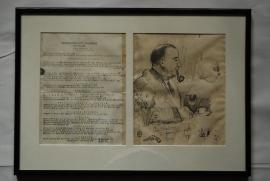
Menu dated 18 November 1937 from Restaurant Jammet and a drawing by Sean O’Sullivan.

The place where all of Dublin wanted to eat, and few could afford, Jammet’s opened in 1901 on Andrew’s Street, but moved to Nassau Street in 1927, where it continued to dazzle until 1967. In “Dublin’s only French restaurant” – a claim sustained for 40 years – W.B. Yeats had his own table, Hilton Edwards and Micheál MacLiammóir were regulars, and visitors ranged from Laurel and Hardy to Walt Disney and Ronald Reagan. The drawing is by the artist Seán Ó Sullivan.

LMOD