Mostrar 1012 resultados

Descrição arquivística
Weekly Freeman sign
IE LMOD 1079 · Item · Twentieth Century

Original white and green metal enamel sign for the 'Weekly Freeman'

Sem título
Smyllie cartoon Warner Smyllie on bicycle
IE LMOD 1085 · Item · Twentieth Century

Copy Smyllie cartoon Warner Smyllie on bicycle: original in Linden Hall library?

Sem título
Daily Sketch June 7th 1922
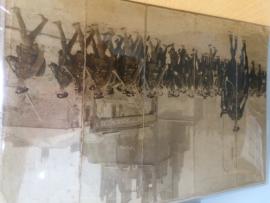
IE LMOD 1092 · Item · Twentieth Century

Daily Sketch June 7th 1922 (End of Civil War)

Sem título
Garret Fitzgerald by Graham Knuttel
IE LMOD 476 · Item · Twentieth Century

Print of Garret Fitzgerald sitting at a desk with multiple objects around him including a train, airplane, books on maths and a calendar on March 16 by Graham Knuttel

Sem título
Éamon De Valera by Graham Knuttel
IE LMOD 477 · Item · Twentieth Century

Print of Éamon De Valera dancing with a girl in and Irish dancing costume at a crossroads with the sign 'Palacio Presidentiale' and 'Beal na Blath' by Graham Knuttel.

Sem título
Aloysius Costello by Graham Knuttel
IE LMOD 479 · Item · Twentieth Century

Print of John Aloysius Costello with an Irish flag sitting at the head of a table of people with British flags representing British colonies by Graham Knuttel.

Sem título
Albert Reynolds by Graham Knuttel
IE LMOD 480 · Item · Twentieth Century

Print of Albert Reynolds in a white suit outside a club called 'Dreamland' by Graham Knuttel.

Sem título
1910s Dolphin's Barn Brick
IE LMOD 481 · Item · Twentieth Century

A grey brick from the Dolphin's Barn birckworks.

The Dolphin’s Barn Brick and Tile Company was established in 1900, and bricks with the Dolphin’s Barn stamp were used widely throughout the city between 1900 and 1942. The distinctive yellowish colour of the bricks means there is a tendency to describe all bricks of a similar colour as ‘Dolphin’s Barn’ bricks, even ones that were produced long before the factory opened. The company was a major employer, and its bricks were used in many notable buildings around Dublin, including the GMB in Trinity College, Steevens’ Hospital and the National Gallery of Ireland. The company merged with the Mount Argus works and the Rathnew Brick Company in 1921. It ceased operation in 1942.

Sem título