Showing 880 results

Archival description
IE LMOD 428 · Item · Twentieth Century

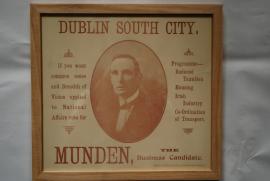
Poster for Patrick Munden running for election in Dublin South City in 1923 showing a photo of Munden in the centre.

Born in 1883 in Allahabad, Patrick Munden was the son of an officer in the Indian Army. A successful architect and engineer, Munden left his mark on Dublin, working on Grangegorman Mental Hospital as well as many churches. A member of the Irish Volunteers, he was involved in the Howth gun-running episode of 1914 and was later held in Dublin Castle during Easter 1916. Munden would go on to represent Rathmines and Pembroke, but on this occasion he failed in a bid for the Dáil, finishing last of 20 candidates in Dublin South, with 0.57% of the vote.

LMOD
1922 War News No. 3
IE LMOD 436 · Item · Twentieth Century

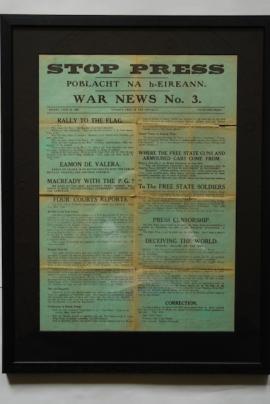
Anti Treaty newspaper from 30 June 1923. Headlines include ‘Stop Press’ ‘Rally to the Flag’ ‘Four Courts Reports’ ‘Where the Free State Guns and Armoured Cars Come From’ ‘To the free State Soldiers’ ‘Press Censorship’ ‘Deceiving the World’

The Anti-Treaty War News includes a report dated 29th of June: “The attack on the Four Courts... is a complete failure...Despite continuous heavy gun and rifle fire, the defences of the Four Courts are intact.” In fact, shelling by the Free State Army, which began on the 28th of June and precipitated outright Civil War, brought about the surrender of the Anti-Treaty’s Dublin headquarters by midday on the1st of July. Quite apart from the damage to one of Dublin’s finest buildings, the incident also saw the destruction of hundreds of years of Irish historical records.

LMOD
1922 War News No. 16
IE LMOD 379 · Item · Twentieth Century

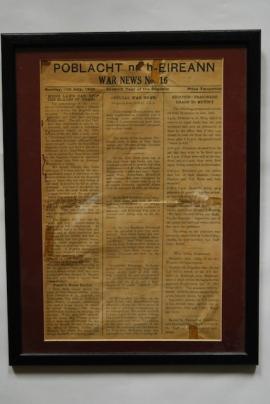
Anti-treaty newspaper dated 'Sunday 16th July 1922, Seventh Year of the Republic' Includes the headlines 'When laws can stop the blades of grass' 'Official War News' 'Shooting Prisoners Leads to Mutiny'

LMOD
IE LMOD 468 · Item · Twentieth Century

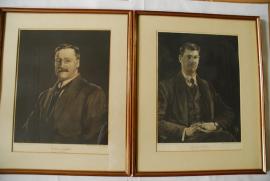
Black and white portrait prints of Michael Collins and Arthur Griffith by John Lavery captioned respectively as Chairman Provisional Government and President Dáil Eiréann.

These famous portraits of Michael Collins and Arthur Griffith by Sir John Lavery were painted during the Civil War. Collins and Griffith were members of the delegation that signed the Anglo-Irish Treaty in 1921. The Treaty did not provide full independence from Britain, Northern Ireland would remain part of the UK and an oath to the King would have to be sworn by all members of the Dáil. The Civil War broke out, which the anti-Treaty side eventually lost. Collins and Griffith were both dead by the end of the war – Collins killed in an ambush, Griffith succumbing to heart failure.

LMOD
IE LMOD 460 · Item · Twentieth Century

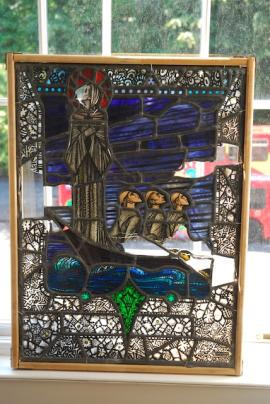
Religious stain glass window by Harry Clarke depicting a saint, possibly St Brendan, standing looking one way and 3 monks kneeling looking in other direction in a boat on water.

Harry Clarke was Ireland’s pre-eminent stained-glass artist. His religious works are renowned for emulating the spirit of Irish medieval manuscript illumination. In his secular designs the Dubliner experimented with innovative new techniques, culminating in his masterpiece ‘The eve of St Agnes’ (1923-24). Clarke’s work was commissioned throughout Ireland and also in Australia and the United States. You can see his stained-glass windows in Bewley’s Café (1927), around the corner from the museum.

LMOD
IE LMOD 6 · Item · Twentieth Century

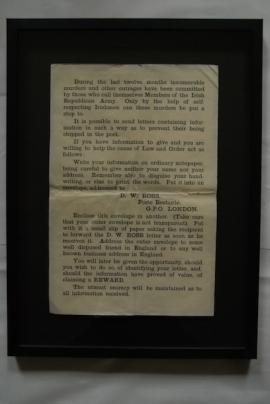
Instruction notice for how to secretly and safely communicate information about the IRA by addressing a letter to D. W. Ross and sending it hidden in another envelope to a trusted friend or business in Britain.

LMOD
1920s National Cash Register
IE LMOD 259 · Item · Twentieth Century

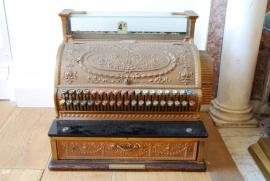
Brass/bronze cash register on wooden base that was used in Findlater's stores. It has predecimalisation numers.

LMOD
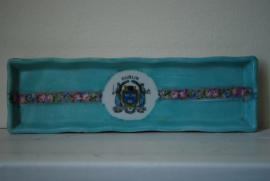
1920s Dublin Pin Tray
IE LMOD 399 · Item · Twentieth Century

Light blue with floral design strip pin tray that has the Dublin Crest in the centre with the motto ‘Obedientia Civium Urbis Felicitas’

LMOD
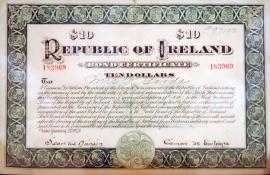
IE LMOD 563 · Item · Twentieth Century

A green and black Republic of Ireland bond certificate for ten dollars dated January 21 1920 with the printed signatures of Eamon de Bhailéara (Éamon De Valera) President, and Seán ua Núnáin, registrar and numbered in red 183969.

During the year and a half he spent crisscrossing the United States, Éamon de Valera used ‘republican bonds’ as a method of fundraising. Raising close to $6 million, the bonds were powerful tools, legitimising the Irish Republic in the eyes of people at home and abroad. However, after the Civil War the issue of whom the money belonged to would prove contentious. This $10 bond is dated January 21st 1920 and was issued to a Mrs. Goode.

LMOD
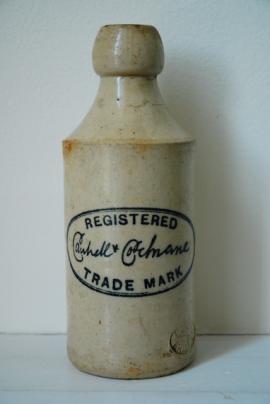
1918 Lemonade Bottle
IE LMOD 267 · Item · Twentieth Century

Cantrell and Cochrane earthenware lemonade bottle containing lemonade, also stamped Price Bristol.
This unopened bottle of lemonade was found by David Casserly in the wreck of the RMS Leinster, in 1991/92, which was sunk by a German submarine in October 1918, two months before the end of the First World War. The greatest disaster in Irish maritime history, the loss of the mail boat off the coast of Dún Laoghaire took the lives of 501 people, including about 300 soliders and nurses returning to the front. The bottle was manufactured by Cantrell and Cochrane, better known as C&C. It was made in Bristol, by the Price stoneware company.

LMOD