Showing 880 results

Archival description
1963 'Dublin Greets Kennedy'
IE LMOD 447 · Item · Twentieth Century

The Irish Times front page for Dublin, Thursday, June 27, 1963 when American president John F Kennedy visited Ireland. Big picture of Kennedy greeting the crowds with De Valera also in the car. Includes articles on the Kennedy trip, transcript of De Valera and Kennedy’s greetings and an article on Kennedy’s trip to Berlin.

The visit of US President John F. Kennedy was seismic. Kennedy was mobbed by autograph-hunters at a garden party held in his honour at the home of the President. Six months later he was killed in Dallas. His address to both houses of the Oireachtas during his trip was a bravura performance; a sort of homecoming, as the Irish Times noted.

LMOD
IE LMOD 412 · Item · Twentieth Century

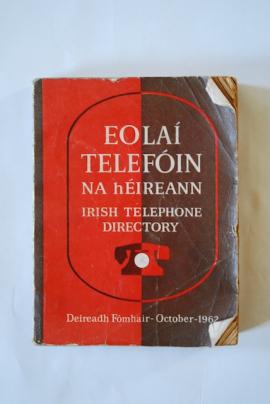
Phone directory with brown and red cover with white writing. ‘Eolaí Telefóin na hÉireann Irish Telephone Directory Deireadh Fómhair – October – 1962

This small telephone directory covers the whole of the Republic of Ireland – and less than half the book is devoted to phone numbers outside of Dublin. The first pages contain instructions on using a phone, with advice like ‘replace receiver before re-dialling,’ and ‘speak directly into the transmitter.’ There was no standard emergency number in those days – it is 999, 9999, 10 or 0, depending on the user’s location.

LMOD
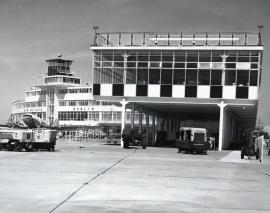
1962 Dublin Airport Terminal
IE LMOD 742 · Item · Twentieth Century

A black and white photograph of Dublin airport.

The airport was a British Royal Flying Corps base during World War I. It was taken over by the Air Corps when Ireland gained independence. Work commenced on the terminal in 1938 after the Government was persuaded to support “such an elaborate plan” despite the fact that annual passenger numbers were only in the hundreds. The tiered design and curvilinear forms echo the lines of the great ocean-going liners.

LMOD
IE LMOD 434 · Item · Twentieth Century

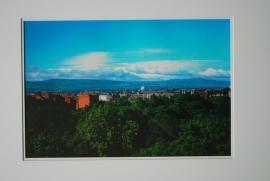
Colour photograph of the view of St. Stephen's Green showing the Dublin Mountains in the background from the Shelbourne Hotel taken by Charles Cushman on 9 June 1961.

This is the view from Charles Cushman’s bedroom in the Shelbourne Hotel on 9 June 1961. St. Stephen’s Green was marshy common-land until 1663, when Dublin Corporation enclosed the centre of the common and sold the perimeter for development. The park was walled-in in 1664, and restricted to local residents until 1877. Sir Arthur Guinness paid for it to be landscaped in 1880. There is a statue of him on the west side of the Green.

LMOD
IE LMOD 430 · Item · Twentieth Century

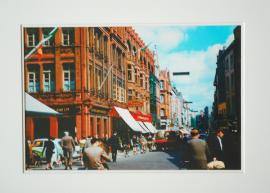
Colour photograph of Grafton Street taken by Charles Cushman on 13 June 1961.

Grafton Street was named after Henry FitzRoy, 1st Duke of Grafton, the illegitimate son of Charles II. The street was developed from a country lane by the Dawson family in 1708. Today it feels like a bland British high street.

LMOD
IE LMOD 431 · Item · Twentieth Century

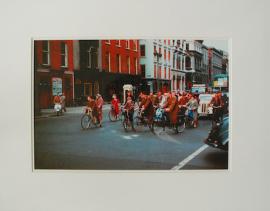
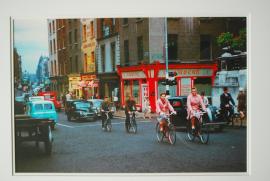
Colour photograph of a large group of cyclists on Dame Street taken by Charles Cushman on 8 June 1961.

LMOD
IE LMOD 433 · Item · Twentieth Century

Colour photograph of Dame Street showing 4 cyclists by City Hall taken by Charles Cushman on 8 June 1961.

LMOD
IE LMOD 429 · Item · Twentieth Century

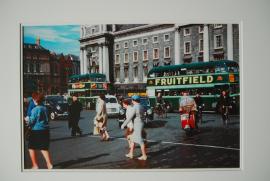
Colour photograph of College Green taken by Charles Cushman on 7 June 1961.

Trinity College takes up most of the background in this photo, with buses passing – College Green is still a bottleneck. The pedantic modern mind notes the absence of lane markings and traffic islands.

LMOD
1960s Switzer's Box
IE LMOD 346 · Item · Twentieth Century

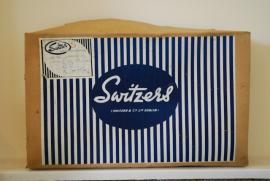
Cardboard box with dark blue/navy and white stripes with Switzer's logo 'Switzer and Co Ltd Dublin'. Delivery information in the top right corner. Seams are stapled together.

Grafton Street was anchored by Switzer’s and Brown Thomas department stores. Switzer’s was the less elite of the two – many customers never crossed the street to shop in Brown Thomas. The basement café was an old-fashioned parlour with waitresses in black dresses and white aprons. Switzer’s was bought by Brown Thomas in 1995; BTs moved into the Switzer’s building across the street. You can still see the Switzer’s logo on the Wicklow Street side of Brown Thomas.

LMOD