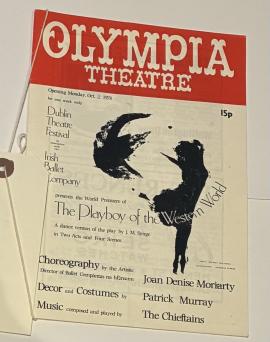
small magazine, black and white cover
LMODBlack and white photograph of Francis Bacon taken by John Minihan in London in 1976 with the written caption ‘Francis Bacon was born in Dublin in 1909, he died in Madrid, Spain in 1992. Bacon was one of the most important painters of the twentieth century. I first met the artist in the early 70s and would photograph him in London and Paris. Bacon worked with photographs, many of his friends were photographers.’
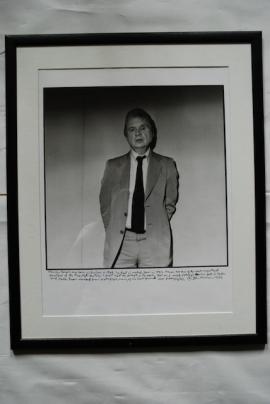
Francis Bacon was born up the road on Baggot Street. But like many other Dubliners – from Edmund Burke to Brendan Bracken – he saw himself as an Englishman. This photograph of Bacon was taken by John Minihan in 1976. Bacon’s paintings were famously bleak and emotionally raw. Margaret Thatcher once called him “that man who paints those dreadful pictures.”
A letter dated 28 October 1976 from Samuel Beckett to John Hughes, who lived in Beckett's old home, in which he lists his old schools and describes where he slept in the house. It includes the line 'If you ever meet my ghost in house or grounds, give it my regards.' Also a black and white photograph of the house in question as well as the envelope.
Playwright Samuel Beckett wrote this letter to schoolboy John Hughes, who was living in the house where Beckett grew up – Cooldrinagh in Foxrock. Say hello to my ghost, urges Beckett.
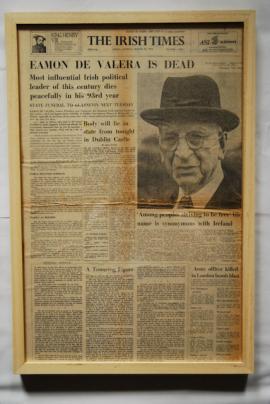
LMODFront page of the Irish Times, Dublin, Saturday, August 30, 1975 when Éamon De Valera died. It has a photo of De Valera and multiple articles about him and his life.
On Saturday 30 August 1975, the Irish Times announced the death of Éamon de Valera. A towering influence, he served multiple terms as a socially conservative Taoiseach and President. De Valera retired from politics in 1973 at the age of 90, the oldest head of state in the world at the time. He is buried in Glasnevin Cemetery.
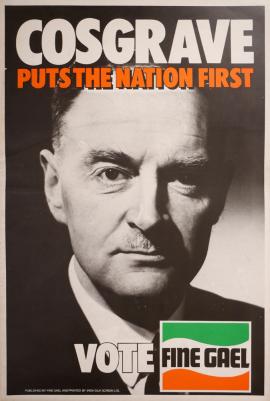
LMODFour Fine Gael election posters Tom O'Higgins (1973 Presidential Election) a double sided poster, published by AF Hussey, Solr. 17 Northumberland Road.
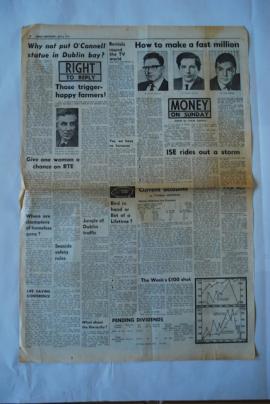
LMODPages 11 and 12 from the Sunday Independent, 9 July 1972.
The Irish Independent was launched in 1905, successor to the Daily Irish Independent. The paper was owned by William Martin Murphy, and stayed in his family until it was purchased by Tony O’Reilly in a protracted coup between February 1972 and March 1973. This issue from July 1972 features a short, sycophantic profile of the new boss – no more, really, than a snapshot of his rapid rise. O’Reilly made his first million that year, and the Independent would soon become the cornerstone of his media empire.
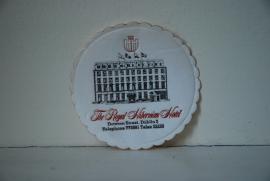
LMODWhite with black and red writing circular drinks mat with a picture of the hotel and caption 'The Royal Hibernian Hotel Dawson Street 2. Telephone: 772991 Telex 25220'
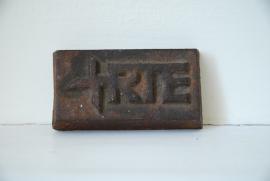
LMODMetal block with raised outline of RTÉ and the St Bridget cross logo.
RTÉ has its origins in 1926, with the creation of 2RN, Ireland’s first radio station. The 1960 Broadcasting act changed its name to Radio Éireann, and made provisions for a new television channel, Telefís Éireann. The introduction of television in 1961 was a major catalyst for social change in Ireland, with imported British and American TV shows and home-grown content like the Late Late Show providing a platform for discussing taboo subjects like contraception and homosexuality.
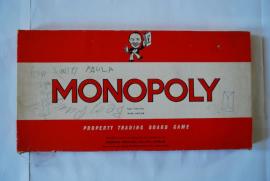
LMODIrish Edition of the game Monopoly with board, money, cards, houses, playing pieces and instruction.
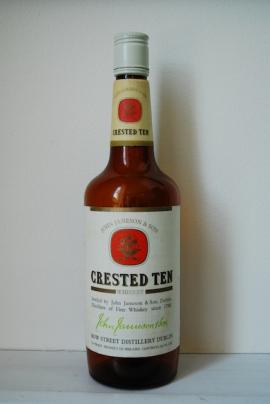
LMODEmpty brown glass bottle of John Jameson and Son whiskey from Bow Street Distillery Dublin
LMOD