Showing 880 results

Archival description
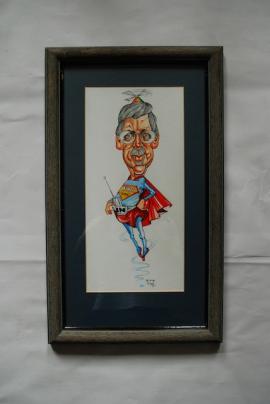
1992 Mike Hogan Cartoon
IE LMOD 462 · Item · Twentieth Century

Cartoon of Mike Hogan dressed as Superman with a mobile phone down the front of his pants and ‘Howya Horse’ on his crest.

Mike Hogan adds to the gaiety of the nation. This is perhaps the sincerest compliment in Dublin. A former Eye in the Sky, Hogan bought the iconic In Dublin magazine for £6,500 when it was in financial trouble and succeeded in turning it around, despite courting scandal with ads for ‘massage parlours’. Hogan once owned 38 magazines. He now works with telecoms magnate Denis O’Brien.

LMOD
IE LMOD 305 · Item · Twentieth Century

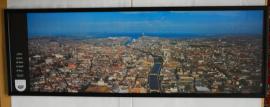
A poster of a panoramic photograph over looking Dublin City taken for the European City of Culture, 1991 with the quote ‘... from swerve of shore to bend of bay ...’ Finnegan’s Wake by James Joyce.
This photo commemorates Dublin’s reign as European City of Culture in 1991. The Scottish Ballet came over to symbolically hand over the title from Glasgow, and there was a 31-hour reading of Ulysses on the radio.

LMOD
IE LMOD 420 · Item · Twentieth Century

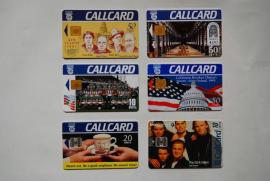
Collection of 6 Telecom Éireann Call Cards from the 1990s
1: Commemorative Dublin Cultural Capital of Europe 1991 showing drawings of four Irish writers Oscar Wilde, Seán O’Casey, James Joyce and George Bernard Shaw. 50 units.
2: Photo of the Long Room in Trinity College Dublin commemorating Trinity’s 400 year anniversary. 50 units.
3: Photo of the Irish football team for the USA World Cup ’94. The back of the card also gives the details of each Ireland match in the first group stage. 10 units.
4: Picture of the roof of the Capitol Building backed by the American flag. ‘Celebrating President Clinton’s historic visit to Ireland, 1995’ 50 units.
5: Photo of a younger hand passing a cup and saucer of tea to older hands. ‘Reach out, Be a good neighbour, Be aware! Care!’ On the back in green writing is also ‘Reach out Your elderly or vulnerable neighbour living alone may need your help! Keep in touch’. 20 units.
6: Photo of Boyzone for Boyzone magazine. 10 units.

Between the era of the payphone and the mobile phone, there was a brief interlude in which the “cardphone” prospered. Telephone companies were keen to promote the cards - because customers paid up front, and often didn’t use their full allocation of credit. (Although an urban myth about recharging the cards by leaving them in your freezer was widely circulated). Small, iconic and fairly durable, these callcards quickly became a collector’s item among schoolboys, philatelists and miscellaneous geeks - traded at market stalls. Phone companies quickly realised they could capitalise on this by selling advertising space on the cards, creating even more collectables in the process. Most payphones in the city were converted to accept callcards. However, the rising ubiquity of mobile/cell phones soon ended the market for callcards.

LMOD
IE LMOD 474 · Item · Twentieth Century

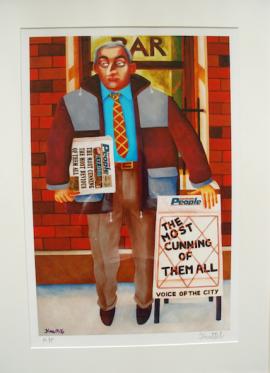
Print of Bertie Ahern standing beside newspaper board with headline 'The Most Cunning of Them All' Headline is also on a Northside People newspaper by Graham Knuttel

Graham Knuttel painted gently satirical pictures of all the Taoisigh. This painting references Ahern’s reputation as a man of the people – his famous anorak, that pub in Drumcondra opposite his constituency office. Charlie Haughey’s much quoted description – “The Most Cunning of Them All” – refers to the other side of Ahern’s reputation.

LMOD
IE LMOD 330 · Item · Twentieth Century

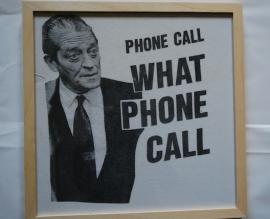
Framed tshirt of black and white picture of Brian Lenihan Snr with the caption 'Phone call, what phone call.'

This t-shirt mocks Brian Lenihan during the 1990 Presidential campaign. The aging statesman was caught spoofing in one of those classic Irish Presidential campaigns (long and bitter). With his credibility damaged, Lenihan lost the election to Mary Robinson.

LMOD
IE LMOD 633 · Item · Twentieth Century

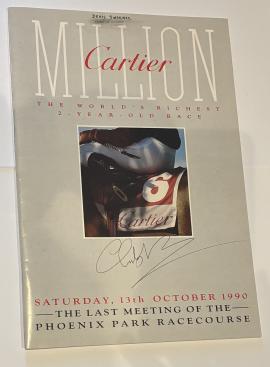
Meeting race card for the last race meeting at the Phoenix Park racecourse dated 13 October 1990, signed by Christy Roche, winner of the last race riding Wild Jester.

LMOD
IE LMOD 443 · Item · Twentieth Century

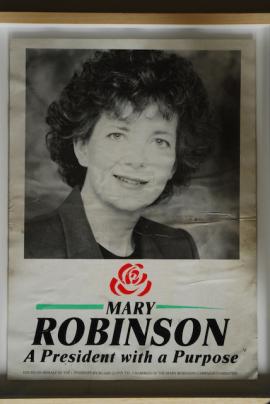
‘Mary Robinson A President With a Purpose’ slogan underneath a black and white photo of Mary Robinson.

Mary Robinson was Ireland’s first female President. Elected in 1990 as an independent candidate with the backing of Labour and the Workers’ Party, she was also the first president elected without the support of Fianna Fáil. Robinson began her career as a senator, fighting to liberalise Ireland in the 1970s – access to contraception was one of her early causes, as well as abolishing a legal requirement that women in the civil service leave their jobs if they married. She was a legal advisor to the Campaign for Homosexual Law Reform, which eventually succeeded in overturning Ireland’s ban on homosexuality in 1992. As President, Mary Robinson revitalised the office, before becoming United Nations High Commissioner on Human Rights.

LMOD
IE LMOD 600 · Item · Twentieth Century

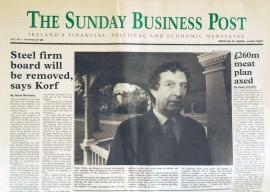
Vol. 1 No. 1 November 26 1989

This is the first edition of the Sunday Business Post, dated November 26 1989. Edited by Damien Kiberd, the paper would benefit from much-increased levels of advertising as Ireland’s economic fortunes improved in the 1990s.

LMOD
IE LMOD 657 · Item · Twentieth Century

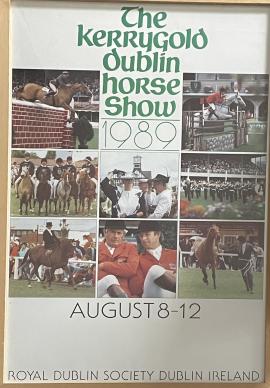
A colour poster for the Kerrygold Dublin Horse Show in the RDS 8-12 August 1989 with green writing a collection of photographs of the Horse Show.

LMOD