Mostrando 880 resultados

Descripción archivística
1980 U2 & Hot Press
IE LMOD 442 · Unidad documental simple · Twentieth Century

Hot Press Vol 3, No 20, March 29th – April 11th. Headline ‘The Class of 80 Goes to London’ with a black and white group photo. Also displays a page from inside the magazine with the article ‘U2 sign to Island’

“By 1980,” recalls John Stephenson, “a young advertising executive called Paul McGuinness had spent the last of his money on a new Dublin band he’d been managing since 1978. McGuinness had persuaded Chris Blackwell of Island Records that U2 were worth considering, but the album deal was far from done.” A showcase in London might do the trick. That’s where Stephenson came in – his Sense of Ireland Festival provided a platform for U2, the Virgin Prunes, Berlin, the Radiators from Space and Paul Cleary. Paul McGuinness persuaded Blackwell to bring the entire Island staff to the Acklam Hall, where U2 were playing as part of the festival. The band signed their first record deal a few days later. Hot Press is Ireland’s music magazine, founded in 1977 and edited to this day by Niall Stokes. The publication championed U2 and is still an important platform for emerging Irish music.

Sin título
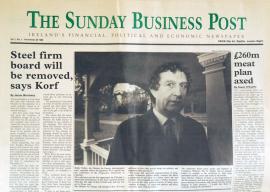
1989 First Issue Sunday Business Post
IE LMOD 600 · Unidad documental simple · Twentieth Century

Vol. 1 No. 1 November 26 1989

This is the first edition of the Sunday Business Post, dated November 26 1989. Edited by Damien Kiberd, the paper would benefit from much-increased levels of advertising as Ireland’s economic fortunes improved in the 1990s.

Sin título
Anything Goes Radio 2 sign
IE LMOD 2198 · Unidad documental simple · Twentieth Century

Large, square, blue wooden sign with "Anything Goes Radio 2" printed in red and yellow.

Sin título
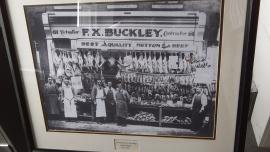
FX Buckley Butchers Moore St.
IE LMOD 1360 · Unidad documental simple · Twentieth Century

Original Black and White Photograph
Black Frame& mounted
This photo is a donation from Frank Buckley, son of the original FX Buckley.

It depicts the FX Buckley butchers on Moore Street. There would have been a dozen butchers on Moore Street; today there are 2. Francis Xavier Buckley is in the middle of the photo with a white coat and a dark apron. Francis was named after the Francis Xavier Church in Gardiner Street. Castle Catholics, his siblings were called John, Mary, William, Edward and Margaret.

Buckley's family came to Dublin from Buckleigh in Wales in the 17th century. They were butchers from the day they arrived, with premises in City Markets, Bull Alley, Patrick Street, Queen Street and, eventually, Moore Street.

Note the price of a sirloin roast, 6 pence a pound, which is roughly 10 cents a pound in today's money; less than a hundredth of what it would cost today.

On the far right of the picture you can see Tommy Mulvaney. What used to be called a confirmed bachelor, Tommy doted on FX, and worked in the shop he was in his late 70s. When FX said you can't be working here every day at your age, he said, "Oh Mr Buckley you can't be telling me not to come in," so they agreed that he would come in only on Fridays and Saturdays. Tommy had a few trinkets, such as a gold watch and tiepin, all of which were left to Mr Buckley upon his death. He was, says Frank, a lonely man for whom this shop was his life.

Sin título
Motorola mobile phone c. 1980
IE LMOD 1100 · Unidad documental simple · Twentieth Century

One motorola mobile phone c. 1980, broken antenna mended with sellotape

Sin título
Framed portrait of Queen Victoria
IE LMOD 1104 · Unidad documental simple · Twentieth Century

Framed portrait of Queen Victoria, supplement to Irish Times April 5th 1900

Sin título
Pastel portrait R. M. Smyllie
IE LMOD 1108 · Unidad documental simple · Twentieth Century

Pastel portrait R. M. Smyllie by Harry Kernoff, signed and dated 1945 original

Sin título