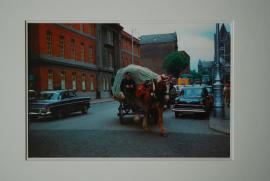
Colour photograph of a horse and cart on Dame Street with Christ Church in the background taken by Charles Cushman on 8 June 1961.
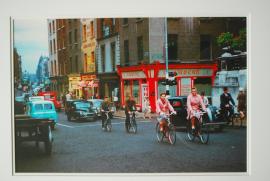
Sem títuloColour photograph of Dame Street showing 4 cyclists by City Hall taken by Charles Cushman on 8 June 1961.
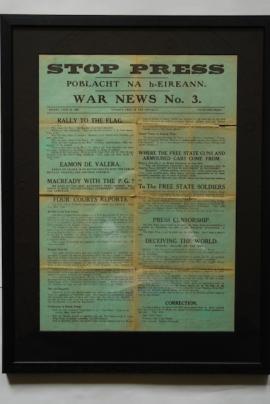
Sem títuloAnti Treaty newspaper from 30 June 1923. Headlines include ‘Stop Press’ ‘Rally to the Flag’ ‘Four Courts Reports’ ‘Where the Free State Guns and Armoured Cars Come From’ ‘To the free State Soldiers’ ‘Press Censorship’ ‘Deceiving the World’
The Anti-Treaty War News includes a report dated 29th of June: “The attack on the Four Courts... is a complete failure...Despite continuous heavy gun and rifle fire, the defences of the Four Courts are intact.” In fact, shelling by the Free State Army, which began on the 28th of June and precipitated outright Civil War, brought about the surrender of the Anti-Treaty’s Dublin headquarters by midday on the1st of July. Quite apart from the damage to one of Dublin’s finest buildings, the incident also saw the destruction of hundreds of years of Irish historical records.
Sem títuloA pink with black writing flyer for event at Blackrock Baths on Saturday 27 August 1949 to see ‘The Swimming Champions From the three countries, England, Scotland and Ireland in action’ and lists those taking part as well as water ballet and water polo.
The Blackrock Baths was created following public outcry at access to the sea being cut off by the building of the Dublin-Kingstown railway line in 1834. Hugely popular, the baths often witnessed displays by Dublin’s great high-diving and springboard-diving champion, Eddie Heron. During the 1980s the baths fell into disuse and were later dismantled and sold to a private firm.
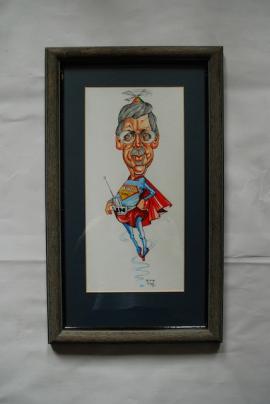
Sem títuloCartoon of Mike Hogan dressed as Superman with a mobile phone down the front of his pants and ‘Howya Horse’ on his crest.
Mike Hogan adds to the gaiety of the nation. This is perhaps the sincerest compliment in Dublin. A former Eye in the Sky, Hogan bought the iconic In Dublin magazine for £6,500 when it was in financial trouble and succeeded in turning it around, despite courting scandal with ads for ‘massage parlours’. Hogan once owned 38 magazines. He now works with telecoms magnate Denis O’Brien.
Sem títuloBlack and white photograph of Samuel Beckett taken by John Minihan in Paris in 1985 with the written caption ‘Samuel Beckett photographed near his home on Boulevard St Jacques, Paris, 1985.’
Samuel Beckett grew up in Foxrock, but spent most of his life in Paris, where he is here captured near his home on the Boulevard St. Jacques. Beckett is most famous for his minimalist plays, often laced with dark humour, like Waiting for Godot and Endgame. The man who took this photograph, John Minihan, is an engaging figure who recalls his youth with a puckish twinkle.
Black and white photograph of a boy, Martin Long, and a horse, Babyface, as taken by Perry Ogden in the 1990s for ‘Pony Kids'.
Perry Ogden is an acclaimed English photographer with a studio on Capel Street. His Pony Kids show was an artistic event of note in the mid-1990s. There is a subculture of young working class horse owners in Dublin’s inner city and some of the city’s most deprived suburbs. Horses and ponies are ridden bareback, bought and sold in Smithfield Square on the first Sunday of every month.
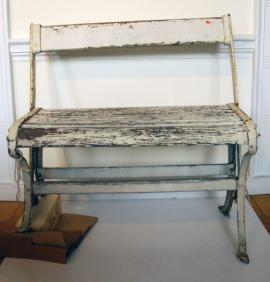
White Dublin tram seat. One leg is shorter than the other due to where the engine/wheel used to be. The seat back can be moved.
One day Dublin will have a tram service as efficient as the last one was when we started to close it down. In the meantime we are left to admire this seat. At the end of the line, the back-rest was simply turned to face the other way.
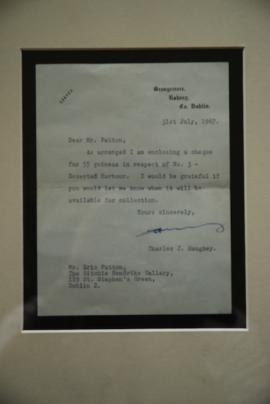
Letter dated 31 July 1967 from Haughey to Eric Patton discussing a payment of 55 guineas.
Charles Haughey was Minister for Finance at the time he wrote this letter to Eric Patton, from the Richie Hendriks Gallery. While the gallery, which was here on Stephen’s Green, was cutting-edge, the painting in question recently sold for just €800. In the same year, Haughey sold his old house in Raheny for £200,000, having bought it for £50,000 ten years earlier. The land had been rezoned in the interim. Opening an office building on St Stephen’s Green that year, he announced, “I, for one, have never believed that all architectural taste and building excellence ceased automatically with the passing of the18th Century.” That same year, 1967, Haughey bought Abbeville, an eighteenth century mansion designed by Gandon.
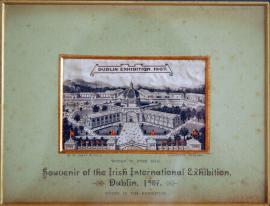
2 pictures woven at the exhibition. The first of a Dublin scene in black and white with red details, gold trimming and bordered by green. The second of of O'Connell (Sackville) Street and Bridge in black and white with gold trimming and bordered by green.
The Irish International Exhibition was the key social event of the first decade. It was hosted on the grounds of Herbert Park in Ballsbridge between May and November of 1907. The aim was to promote domestic industry by showcasing Irish products, as well as encouraging the development of commercial links by inviting all countries to exhibit their goods. Nearly three million visitors came to ogle at everything from industrial machinery to fine art, but the main attraction was a full-scale Somali village and the rare whimsy of a water chute and switchback railway. One of these pictures shows the central exhibition hall; the other captures a scene from O’Connell Bridge.