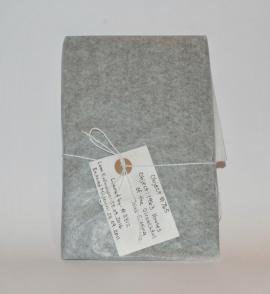
A small green book containing a transcript of the speech given by American President John F. Kennedy to the joint Houses of the Oireachtas.
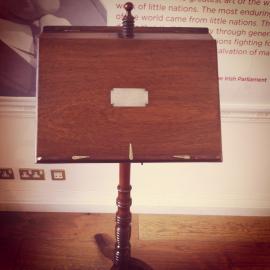
LMODA wooden music stand that was used as a lectern by John F Kennedy. on the centre of the stand is a small metal plaque inscribed with 'This stand was used by John F. Kennedy President, United States of America when addressing Dáil and Seanad Eireann in Leinster House 28th June 1963. It was loaned for the occasion by Comdt John P. Brennock Asst Director Army School of Music.'
On 28 June, President John F Kennedy addressed both houses of the Oireachtas. It was a historic visit, not least because Kennedy, a young, dynamic Irish-American, had long made much of his Irish roots. Speaking at this lectern, Kennedy described his heritage, made an attack on literary censorship and noted – to the delight of the assembled politicians – that Leinster House “does not inspire the brightest ideas.”
The ‘lectern’ is actually a music stand that was owned by John Brennock, who bought it in an antique shop on Fishamble Street. During one of many meetings to prepare for President Kennedy’s visit, it was realised that the Dáil chamber did not have a lectern that could be used for a speech – TDs address the Dáil from where they are seated. Mr Brennock offered to lend his music stand to the Oireachtas. By the time the stand was returned – strapped to the top of a car – Kennedy had already been shot.
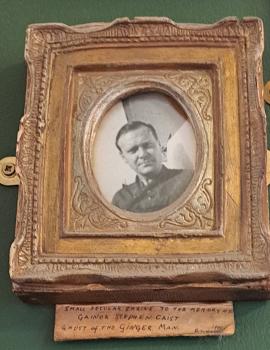
A small secular shrine with a black and white photo of Gainor Crist in a bronze coloured frame with the caption 'Small Secular Shrie to the Memory of Gainor Stephen Crist Ghost of the Ginger Man. 1995 D MacNamara' and on the back is written 'This is the ginger man's only memorial. Hang it where boozers booze, but fix firmly to wall. I couldn't find Paddy O'Briens, or any other ghost in McDaids so - It has to be Grogans. Mac'
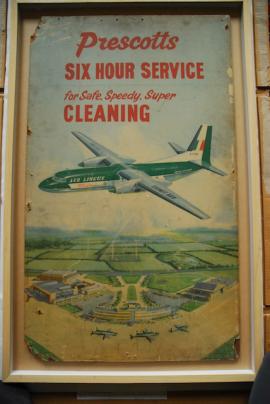
LMODPrescott's six hour service for safe, speedy, super cleaning' Colour poster showing an Aer Lingus plane flying over Dublin airport and green fields.
This poster has nothing to do with air travel. It is an ad for Prescott’s dry cleaners in Drumcondra, near the airport. The pitch borrows the glamour and speed of commercial air travel to make a mundane service seem more exciting. The plane in the picture – a Fokker Friendship – puts thead some time between 1958 and 1966, when the Friendships were phased out of service. A miniature incarnation of Dublin airport is depicted at the bottom of the ad. The airport was designed by Desmond Fitzgerald, who was only 26 years old when he secured the commission.
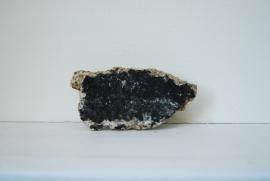
LMODA piece of rock from Nelson's Pillar from after it was blown up in 1966.
This piece of granite is from Nelson’s Pillar on O’Connell Street, which was blown up by the IRA at 2am on 8 March 1966. Bombs destroyed the upper half of the pillar and threw the statue of Nelson into the street. Several days later, the Irish army demolished the remains of the pillar, causing more damage to O’Connell Street than the original blast. Nelson’s head was stored in a shed on Clanbrassil Street, before being stolen by students from the National College of Art and Design as a fund-raising prank. It was leased to a London antique store owner, and later appeared on the stage of the Olympia when the Dubliners performed. The head of Nelson’s Pillar is now on display in the excellent Dublin City Library and Archive on Pearse Street.
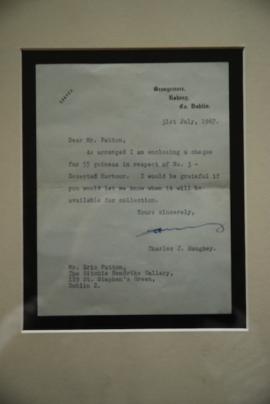
LMODLetter dated 31 July 1967 from Haughey to Eric Patton discussing a payment of 55 guineas.
Charles Haughey was Minister for Finance at the time he wrote this letter to Eric Patton, from the Richie Hendriks Gallery. While the gallery, which was here on Stephen’s Green, was cutting-edge, the painting in question recently sold for just €800. In the same year, Haughey sold his old house in Raheny for £200,000, having bought it for £50,000 ten years earlier. The land had been rezoned in the interim. Opening an office building on St Stephen’s Green that year, he announced, “I, for one, have never believed that all architectural taste and building excellence ceased automatically with the passing of the18th Century.” That same year, 1967, Haughey bought Abbeville, an eighteenth century mansion designed by Gandon.
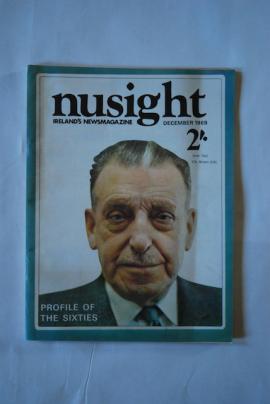
Nusight magazine dated December 1969 with headline ‘Profile of the Sixties’ and a picture of Sean Lemass.
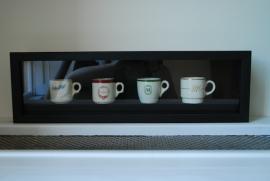
LMOD1: Dolphin Hotel -Their logo in black on a white cup.
2:Royal Marine Hotel, Dún Laoghaire - White cup with wine coloured logo and a wine and gold stripe around the rim.
3: Metropolitan Hotel - White cup with a green M logo and a green stripe around the rim.
4: Royal Hibernia Hotel - White cup with RH logo in gold with a gold stripe around the rim.
- Dolphin Hotel. This fine Gothic building is on East Essex Street. It was later converted into Dublin District Court offices.
- Royal Marine Hotel. Originally the Hayes Royal Hotel (1828), the hotel was bought in 1863 by William Dargan, builder of the Kingstown Railway, and was rebuilt and reopened as the Royal Marine Hotel in 1865.
- The Metropole Hotel. During the 1916 Rising this hotel, adjacent to the GPO, was completely destroyed. The same site is now home to Penney’s clothing store.
- Royal Hibernian Hotel. Formerly located on Dawson Street, this grand old hotel was demolished in the 1980s to make way for the Royal Hibernian Way.
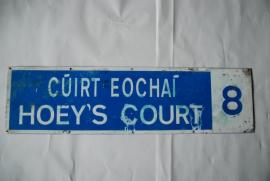
Blue and white Dublin 8 street sign ‘Hoey’s Court’ ‘Cúirt Eochaí’
Hoey’s Court would mean nothing to the world, or indeed to Dubliners, except that Jonathan Swift was born here in 1667.
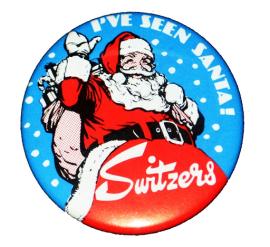
LMODI've Seen Santa' badge for Switzers with a picture of a waving Santa.
Switzer’s department store had the best in-house Santa Claus, and their Christmas window displays were a seasonal benison. With lights, music and animatronic puppets, people would make trips from all over the country just to visit this much-missed institution.
LMOD