nonfiction, historic Ireland, 1800s, 1900s, Irish art, Irish writers, culture, biography, hardback
Sin títulononfiction, historic Dublin, 1300s, society, paperback
Sin títulononfiction historic Ireland, 1900s, Irish writers, biography, culture, Europe,hardback
Sin títulononfiction, historical Ireland, 1800s, Britain, Europe, letters, Irish writers, culture, hardback
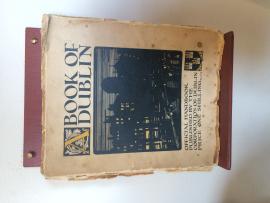
Sin títuloA Book of Dublin Official Handbook Published by the corporation of Dublin'
nonfiction, historic Dublin, 1900s, guide book, illustrations, paperback
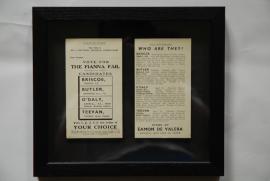
A Fianna Fáil voting card for Dublin South West constituency listing their four candidates, Robert Briscoe, Bernard Butler, Carroll O’Daly and Thomas Teevan and some inforamtion about them.
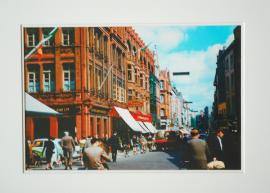
Sin títuloColour photograph of Grafton Street taken by Charles Cushman on 13 June 1961.
Grafton Street was named after Henry FitzRoy, 1st Duke of Grafton, the illegitimate son of Charles II. The street was developed from a country lane by the Dawson family in 1708. Today it feels like a bland British high street.
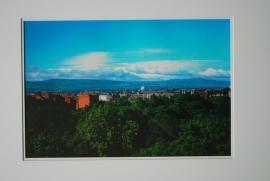
Sin títuloColour photograph of the view of St. Stephen's Green showing the Dublin Mountains in the background from the Shelbourne Hotel taken by Charles Cushman on 9 June 1961.
This is the view from Charles Cushman’s bedroom in the Shelbourne Hotel on 9 June 1961. St. Stephen’s Green was marshy common-land until 1663, when Dublin Corporation enclosed the centre of the common and sold the perimeter for development. The park was walled-in in 1664, and restricted to local residents until 1877. Sir Arthur Guinness paid for it to be landscaped in 1880. There is a statue of him on the west side of the Green.
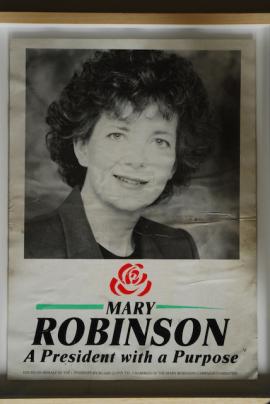
Sin título‘Mary Robinson A President With a Purpose’ slogan underneath a black and white photo of Mary Robinson.
Mary Robinson was Ireland’s first female President. Elected in 1990 as an independent candidate with the backing of Labour and the Workers’ Party, she was also the first president elected without the support of Fianna Fáil. Robinson began her career as a senator, fighting to liberalise Ireland in the 1970s – access to contraception was one of her early causes, as well as abolishing a legal requirement that women in the civil service leave their jobs if they married. She was a legal advisor to the Campaign for Homosexual Law Reform, which eventually succeeded in overturning Ireland’s ban on homosexuality in 1992. As President, Mary Robinson revitalised the office, before becoming United Nations High Commissioner on Human Rights.
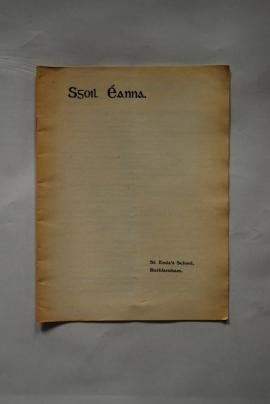
Sin títuloProspectus for St. Enda’s School, Rathfarnham for year 1910 – 1911 Head Master Pádraig Pearse
This school prospectus encapsulates the two great loves of P.H. Pearse’s life: education and the Irish l anguage. Greatly encouraged by the example of Belgian schools, in 1908 Pearse founded Scoil Éanna in Ranelagh, a bilingual school for boys, followed shortly in 1910 by a girls’ school, Scoil Íde. As well as teaching through both Irish and English, Pearse pursued and pioneered a child-centred approach to education. His 1912 collection of essays, The Murder Machine, was an indictment of the British education system, placing Pearse at the forefront of educational innovation.
Sin título