Previsualizar a impressão Fechar

Mostrar 2082 resultados

Descrição arquivística
880 resultados com objetos digitais Mostrar resultados com objetos digitais
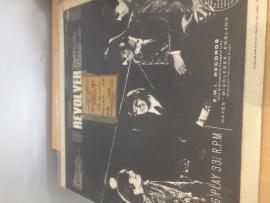
The Beatles Ticket + Revolver Album Sleeve
IE LMOD 1761 · Item · Twentieth Century

A ticket for 'The Beatles' at the Adelphi Dublin on November 7th 1963 at 6:30pm, mounted on a Revolver 1966 Mono Album Sleeve (empty)

Sem título
Jammets Spoon and Knife
IE LMOD 1769 · Item · Twentieth Century

A metal spoon with Jammets engraved into the handle and knife with same

Sem título
The Dublin Gazette 1921
IE LMOD 1777 · Item · Twentieth Century
Sem título
1990s Collection of call cards
IE LMOD 420 · Item · Twentieth Century

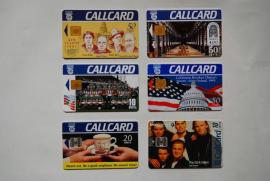
Collection of 6 Telecom Éireann Call Cards from the 1990s
1: Commemorative Dublin Cultural Capital of Europe 1991 showing drawings of four Irish writers Oscar Wilde, Seán O’Casey, James Joyce and George Bernard Shaw. 50 units.
2: Photo of the Long Room in Trinity College Dublin commemorating Trinity’s 400 year anniversary. 50 units.
3: Photo of the Irish football team for the USA World Cup ’94. The back of the card also gives the details of each Ireland match in the first group stage. 10 units.
4: Picture of the roof of the Capitol Building backed by the American flag. ‘Celebrating President Clinton’s historic visit to Ireland, 1995’ 50 units.
5: Photo of a younger hand passing a cup and saucer of tea to older hands. ‘Reach out, Be a good neighbour, Be aware! Care!’ On the back in green writing is also ‘Reach out Your elderly or vulnerable neighbour living alone may need your help! Keep in touch’. 20 units.
6: Photo of Boyzone for Boyzone magazine. 10 units.

Between the era of the payphone and the mobile phone, there was a brief interlude in which the “cardphone” prospered. Telephone companies were keen to promote the cards - because customers paid up front, and often didn’t use their full allocation of credit. (Although an urban myth about recharging the cards by leaving them in your freezer was widely circulated). Small, iconic and fairly durable, these callcards quickly became a collector’s item among schoolboys, philatelists and miscellaneous geeks - traded at market stalls. Phone companies quickly realised they could capitalise on this by selling advertising space on the cards, creating even more collectables in the process. Most payphones in the city were converted to accept callcards. However, the rising ubiquity of mobile/cell phones soon ended the market for callcards.

Sem título
1989 4 St. Stephen’s Green Stamps
IE LMOD 425 · Item · Twentieth Century

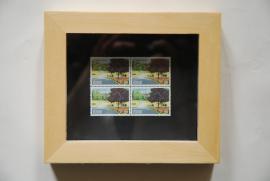
4 identical 50 p stamps showing a colour drawing of St. Stephen’s Green.

Sem título
1923 Patrick Munden Election Poster
IE LMOD 428 · Item · Twentieth Century

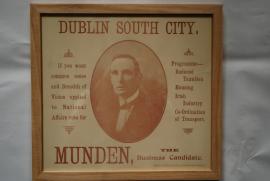
Poster for Patrick Munden running for election in Dublin South City in 1923 showing a photo of Munden in the centre.

Born in 1883 in Allahabad, Patrick Munden was the son of an officer in the Indian Army. A successful architect and engineer, Munden left his mark on Dublin, working on Grangegorman Mental Hospital as well as many churches. A member of the Irish Volunteers, he was involved in the Howth gun-running episode of 1914 and was later held in Dublin Castle during Easter 1916. Munden would go on to represent Rathmines and Pembroke, but on this occasion he failed in a bid for the Dáil, finishing last of 20 candidates in Dublin South, with 0.57% of the vote.

Sem título
1988 Valedictory Verses by Séamus Heaney
IE LMOD 435 · Item · Twentieth Century

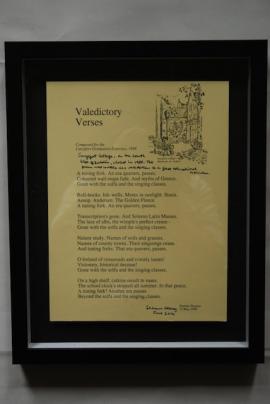
Signed print of the poem Valedictory Verse by Seamus Heaney ‘composed for the Carysfort Graduation Exercises, 1988’ with an illustration of Carysfort College, Blackrock, Co. Dublin in the top right corner. Dated June 2011.

Séamus Heaney wrote this poem to mark “a significant moment in the history of Dublin” – the closure of Carysfort College in Blackrock. The Nobel-prize winning poet taught at the teacher-training college between 1975 and 1981, before he took up a position at Harvard. Carysfort was founded in 1877 as a college for Catholic girls who wished to become teachers. Other lecturers at the college included Éamon de Valera and Eoin MacNeill, co-founder of the Gaelic League and founder of the Irish Volunteers. The poem was written, as Heaney notes, “to mark the end of an era.”

Sem título