Government, Politics & Reform

Elements area

Taxonomy

Code

Scope note(s)

    Source note(s)

      Display note(s)

        Hierarchical terms

        Government, Politics & Reform

          Equivalent terms

          Government, Politics & Reform

            Associated terms

            Government, Politics & Reform

              87 Archival description results for Government, Politics & Reform

              87 results directly related Exclude narrower terms
              IE LMOD 2212 · Item · Twentieth Century

              Two red and blue scarves in a large red box with a holographic trading card on the front that changes from King George VI to Queen Elizabeth II

              LMOD
              IE LMOD 3 · Item · Twentieth Century

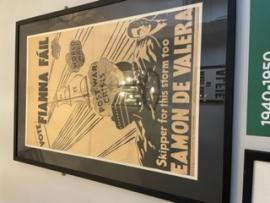
              Black and white 'Vote Fianna Fáil' election poster with a drawing of a ship at sea with clouds containing the words 'Post war crisis' 'World war' and 'economic war'. 'Skipper for this storm too, Éamon De Valera'

              LMOD
              IE LMOD 2 · Item · Twentieth Century

              Poster. 'Workers!' Lists positive Fianna Fáil achievements for workers and promises more. 'Fianna Fáil is on your side. Always was and always will be.'

              LMOD
              IE LMOD 708 · Item · Twentieth Century

              A black and white photograph of a banner hanging in front of the Ierish tims building showing the election results by how many seats each party has. From Getty 'Election results posted on at The Irish Times on the 1 February 1948.'

              LMOD
              IE LMOD 705 · Item · Twentieth Century

              A black and white photograph of Winston Churchill being followed by Brendan Braken out of 10 Downing Street by Central Press. With Braken's signature also in the bottom of the frame. From Getty 'Prime Minister Winston Churchill (1874 – 1965) leaves Downing Street in London with Irish journalist and Conservative politician Brendan Braken (1901 – 1958).'

              Winston Churchill leaves 10 Downing Street with his ‘faithful chela,’ Brendan Bracken. One of the most mysterious Dubliners of the 20th Century, Bracken was an adventurer who tried to disguise his roots (Dublin/Tipperary), claiming instead to be Australian. A Tory MP at the age of 28, he published both the Economist and the Financial Times, and was loyal to Churchill when the latter had been cast into the political wilderness after the First World War. In 1940, when Ireland practiced scrupulous neutrality, Brendan Bracken played a key role in Churchill’s succession as Prime Minister, and went on to serve as Minister of Information for three years. Viscount Bracken died in 1958 at the age of 57. He is the subject of an excellent biography by fellow Dubliner Charles Lysaght.

              LMOD
              IE LMOD 278 · Item · Twentieth Century

              Signed black and white photo of De Valera at the desk of An Taoiseach, taken during the period of of the 1937 general election. Published on the cover of June 1937 Fianna Fáil Bulletin.

              LMOD
              IE LMOD 428 · Item · Twentieth Century

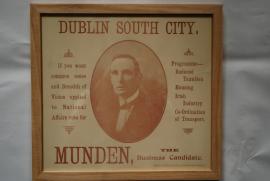
              Poster for Patrick Munden running for election in Dublin South City in 1923 showing a photo of Munden in the centre.

              Born in 1883 in Allahabad, Patrick Munden was the son of an officer in the Indian Army. A successful architect and engineer, Munden left his mark on Dublin, working on Grangegorman Mental Hospital as well as many churches. A member of the Irish Volunteers, he was involved in the Howth gun-running episode of 1914 and was later held in Dublin Castle during Easter 1916. Munden would go on to represent Rathmines and Pembroke, but on this occasion he failed in a bid for the Dáil, finishing last of 20 candidates in Dublin South, with 0.57% of the vote.

              LMOD
              IE LMOD 468 · Item · Twentieth Century

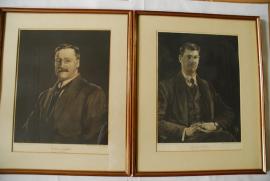
              Black and white portrait prints of Michael Collins and Arthur Griffith by John Lavery captioned respectively as Chairman Provisional Government and President Dáil Eiréann.

              These famous portraits of Michael Collins and Arthur Griffith by Sir John Lavery were painted during the Civil War. Collins and Griffith were members of the delegation that signed the Anglo-Irish Treaty in 1921. The Treaty did not provide full independence from Britain, Northern Ireland would remain part of the UK and an oath to the King would have to be sworn by all members of the Dáil. The Civil War broke out, which the anti-Treaty side eventually lost. Collins and Griffith were both dead by the end of the war – Collins killed in an ambush, Griffith succumbing to heart failure.

              LMOD
              IE LMOD 275 · Item · Twentieth Century

              Letter dated 7 October 1921, appointing Arthur Griffith, Michael Collins, Robert C Barton, Edmund J Duggan and George Gavan Duffy as Envoy Plenipotentiaries in both English and Irish (the Irish copy is embossed with the seal of the president) signed by Éamon De Valera. Also a list of instructions and rules for the plenipotentiary team.
              This is the most important historical document in the museum. Appointing Dáil Éireann’s delegation for the Anglo-Irish Treaty negotiations, it includes signed instructions from Éamon de Valera, who had recently been chosen as Dáil President by his colleagues. It is one of five original copies, and for 40 years the document languished at the back of a filing cabinet in a law firm on Ormond Quay. The exact role and powers of the plenipotentiaries would be disputed in the bitter debate that surrounded the Dáil’s ratification of the Treaty.

              LMOD