Government, Politics & Reform

Elements area

Taxonomy

Code

Scope note(s)

    Source note(s)

      Display note(s)

        Hierarchical terms

        Government, Politics & Reform

          Equivalent terms

          Government, Politics & Reform

            Associated terms

            Government, Politics & Reform

              87 Archival description results for Government, Politics & Reform

              87 results directly related Exclude narrower terms
              IE LMOD 727 · Item · Twentieth Century

              A black and white postcard saying 'Fianna Fáil Candidates Dublin Finglas Area' showing black and white photographs of the three candidates with their professions underneath: Bertie Ahern (Accountant), Danny Bell (Councillor), Jim Tunney (shadow minister). Signed 'My first election, June '77 Bertie Ahern'

              Bertie Ahern was either an anorak-wearing man of the people or a political operator so smooth that nothing would stick to him – the Teflon Taoiseach. He resigned in 2008, giving his successor the ultimate hospital pass.

              LMOD
              IE LMOD 1677 · Item · Twentieth Century

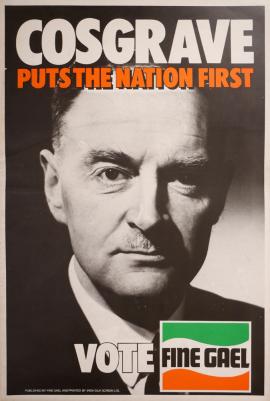
              Four Fine Gael election posters Tom O'Higgins (1973 Presidential Election) a double sided poster, published by AF Hussey, Solr. 17 Northumberland Road.

              LMOD
              IE LMOD 760 · Item · Twentieth Century

              A black and white photo taken by Eddie Kelly showing a group of women with an Irish Womens Liberation Movement banner at Connolly Station taking part in the contraceptive train to get contraception from Northern Ireland.

              LMOD
              IE LMOD 294 · Item · Twentieth Century

              Print of a colour photographic portrait of Charles Haughey taken during the 1970s by Colman Doyle
              Charles Haughey’s career was chequered, and he lived rather well for a modest public servant. He was dismissed from the cabinet in 1970 along with Neil Blaney for allegedly conspiring to import arms into Northern Ireland for the IRA. Cleared of all criminal charges, Haughey fought to regain a seat in the cabinet, and later became party leader and Taoiseach.

              LMOD
              IE LMOD 731 · Item · Twentieth Century

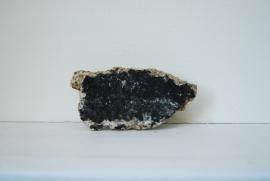
              This piece of granite is alleged to be from Nelson's Pillar on O'Connell Street, which was blown up by the IRA at 2am on 8 March 1966. Bombs destroyed the upper half of the pillar, causing more damage to O'Connell Street than the original blast. Nelson's head was stored in a shed on Clanbrassil Street, before being stolen by students from the National College of Art and Design as a fund raising prank. It was leased to a London antique store owner, and later appeared on the stage of the Olympia when the Dubliners performed. The head of Nelson's Pillar is now on display in the excellent Dublin City Library and Archive on Pearse Street.

              LMOD
              IE LMOD 342 · Item · Twentieth Century

              A piece of rock from Nelson's Pillar from after it was blown up in 1966.

              This piece of granite is from Nelson’s Pillar on O’Connell Street, which was blown up by the IRA at 2am on 8 March 1966. Bombs destroyed the upper half of the pillar and threw the statue of Nelson into the street. Several days later, the Irish army demolished the remains of the pillar, causing more damage to O’Connell Street than the original blast. Nelson’s head was stored in a shed on Clanbrassil Street, before being stolen by students from the National College of Art and Design as a fund-raising prank. It was leased to a London antique store owner, and later appeared on the stage of the Olympia when the Dubliners performed. The head of Nelson’s Pillar is now on display in the excellent Dublin City Library and Archive on Pearse Street.

              LMOD
              1963 John F. Kennedy Lectern
              IE LMOD 699 · Item · Twentieth Century

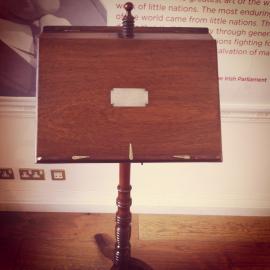
              A wooden music stand that was used as a lectern by John F Kennedy. on the centre of the stand is a small metal plaque inscribed with 'This stand was used by John F. Kennedy President, United States of America when addressing Dáil and Seanad Eireann in Leinster House 28th June 1963. It was loaned for the occasion by Comdt John P. Brennock Asst Director Army School of Music.'

              On 28 June, President John F Kennedy addressed both houses of the Oireachtas. It was a historic visit, not least because Kennedy, a young, dynamic Irish-American, had long made much of his Irish roots. Speaking at this lectern, Kennedy described his heritage, made an attack on literary censorship and noted – to the delight of the assembled politicians – that Leinster House “does not inspire the brightest ideas.”
              The ‘lectern’ is actually a music stand that was owned by John Brennock, who bought it in an antique shop on Fishamble Street. During one of many meetings to prepare for President Kennedy’s visit, it was realised that the Dáil chamber did not have a lectern that could be used for a speech – TDs address the Dáil from where they are seated. Mr Brennock offered to lend his music stand to the Oireachtas. By the time the stand was returned – strapped to the top of a car – Kennedy had already been shot.

              LMOD
              IE LMOD 764 · Item · Twentieth Century

              A black and white photo showing John F. Kennedy making a speech in front of the Houses of the Oireachtas taken from one side of the chamber. It is captioned with 'The President of the United States of America - John F. Kennedy addresses a joint sitting of the Houses of the Oireachtas - June 28th 1963'

              LMOD
              1963 'Dublin Greets Kennedy'
              IE LMOD 447 · Item · Twentieth Century

              The Irish Times front page for Dublin, Thursday, June 27, 1963 when American president John F Kennedy visited Ireland. Big picture of Kennedy greeting the crowds with De Valera also in the car. Includes articles on the Kennedy trip, transcript of De Valera and Kennedy’s greetings and an article on Kennedy’s trip to Berlin.

              The visit of US President John F. Kennedy was seismic. Kennedy was mobbed by autograph-hunters at a garden party held in his honour at the home of the President. Six months later he was killed in Dallas. His address to both houses of the Oireachtas during his trip was a bravura performance; a sort of homecoming, as the Irish Times noted.

              LMOD