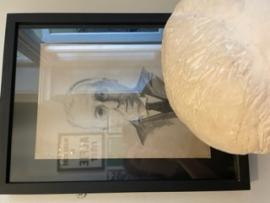
Picture of Sean T. O'Kelly by Sean Dixon. Framed. President of Ireland 1945-1959
Sin títuloGovernment, Politics & Reform
87 Descripción archivística resultados para Government, Politics & Reform
A colour photograph of a group of people at the Pride Parade with banners behind them.
The 1993 Pride Parade was held the day after the old criminal laws were abolished, and the celebrations on the steps of the Central Bank were, in the words of photographer Christopher Robson, “wild and memorable.”
Sin títuloA letter dated May 17 1996 from President Bill Clinton to Frank Feely, city manager, thanking him for his help during his trip to Ireland with the seal of the president at the top.
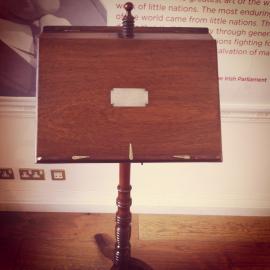
Sin títuloA wooden music stand that was used as a lectern by John F Kennedy. on the centre of the stand is a small metal plaque inscribed with 'This stand was used by John F. Kennedy President, United States of America when addressing Dáil and Seanad Eireann in Leinster House 28th June 1963. It was loaned for the occasion by Comdt John P. Brennock Asst Director Army School of Music.'
On 28 June, President John F Kennedy addressed both houses of the Oireachtas. It was a historic visit, not least because Kennedy, a young, dynamic Irish-American, had long made much of his Irish roots. Speaking at this lectern, Kennedy described his heritage, made an attack on literary censorship and noted – to the delight of the assembled politicians – that Leinster House “does not inspire the brightest ideas.”
The ‘lectern’ is actually a music stand that was owned by John Brennock, who bought it in an antique shop on Fishamble Street. During one of many meetings to prepare for President Kennedy’s visit, it was realised that the Dáil chamber did not have a lectern that could be used for a speech – TDs address the Dáil from where they are seated. Mr Brennock offered to lend his music stand to the Oireachtas. By the time the stand was returned – strapped to the top of a car – Kennedy had already been shot.
A black and white photograph of a banner hanging in front of the Ierish tims building showing the election results by how many seats each party has. From Getty 'Election results posted on at The Irish Times on the 1 February 1948.'
Sin títuloA black and white postcard saying 'Fianna Fáil Candidates Dublin Finglas Area' showing black and white photographs of the three candidates with their professions underneath: Bertie Ahern (Accountant), Danny Bell (Councillor), Jim Tunney (shadow minister). Signed 'My first election, June '77 Bertie Ahern'
Bertie Ahern was either an anorak-wearing man of the people or a political operator so smooth that nothing would stick to him – the Teflon Taoiseach. He resigned in 2008, giving his successor the ultimate hospital pass.
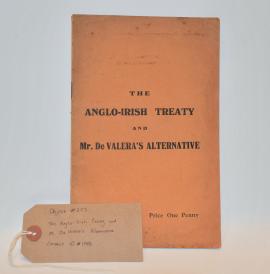
Sin títulononfiction, historic Ireland, 1900s, Britain, politics, nationalism, paperback
Sin títuloPainting by Mick O'Dea
Sin títuloPoster that says Sinn Fein and The Others, declaring who voted for independence and who remained loyalists
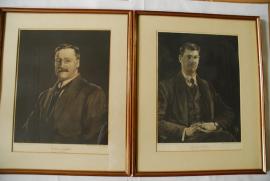
Sin títuloBlack and white portrait prints of Michael Collins and Arthur Griffith by John Lavery captioned respectively as Chairman Provisional Government and President Dáil Eiréann.
These famous portraits of Michael Collins and Arthur Griffith by Sir John Lavery were painted during the Civil War. Collins and Griffith were members of the delegation that signed the Anglo-Irish Treaty in 1921. The Treaty did not provide full independence from Britain, Northern Ireland would remain part of the UK and an oath to the King would have to be sworn by all members of the Dáil. The Civil War broke out, which the anti-Treaty side eventually lost. Collins and Griffith were both dead by the end of the war – Collins killed in an ambush, Griffith succumbing to heart failure.
Sin título