Identity area
Reference code
Title
Date(s)
- Twentieth Century (Creation)
Level of description
Extent and medium
Plastic. 5.5 x 8.5 cm
Context area
Name of creator
Biographical history
Archival history
25/07/2011
Content and structure area
Scope and content
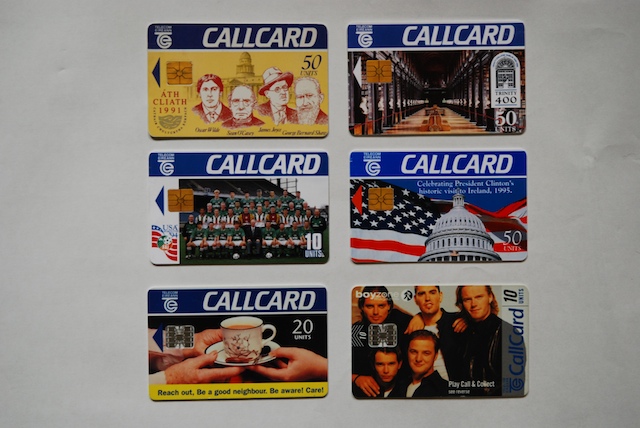
Collection of 6 Telecom Éireann Call Cards from the 1990s
1: Commemorative Dublin Cultural Capital of Europe 1991 showing drawings of four Irish writers Oscar Wilde, Seán O’Casey, James Joyce and George Bernard Shaw. 50 units.
2: Photo of the Long Room in Trinity College Dublin commemorating Trinity’s 400 year anniversary. 50 units.
3: Photo of the Irish football team for the USA World Cup ’94. The back of the card also gives the details of each Ireland match in the first group stage. 10 units.
4: Picture of the roof of the Capitol Building backed by the American flag. ‘Celebrating President Clinton’s historic visit to Ireland, 1995’ 50 units.
5: Photo of a younger hand passing a cup and saucer of tea to older hands. ‘Reach out, Be a good neighbour, Be aware! Care!’ On the back in green writing is also ‘Reach out Your elderly or vulnerable neighbour living alone may need your help! Keep in touch’. 20 units.
6: Photo of Boyzone for Boyzone magazine. 10 units.
Between the era of the payphone and the mobile phone, there was a brief interlude in which the “cardphone” prospered. Telephone companies were keen to promote the cards - because customers paid up front, and often didn’t use their full allocation of credit. (Although an urban myth about recharging the cards by leaving them in your freezer was widely circulated). Small, iconic and fairly durable, these callcards quickly became a collector’s item among schoolboys, philatelists and miscellaneous geeks - traded at market stalls. Phone companies quickly realised they could capitalise on this by selling advertising space on the cards, creating even more collectables in the process. Most payphones in the city were converted to accept callcards. However, the rising ubiquity of mobile/cell phones soon ended the market for callcards.